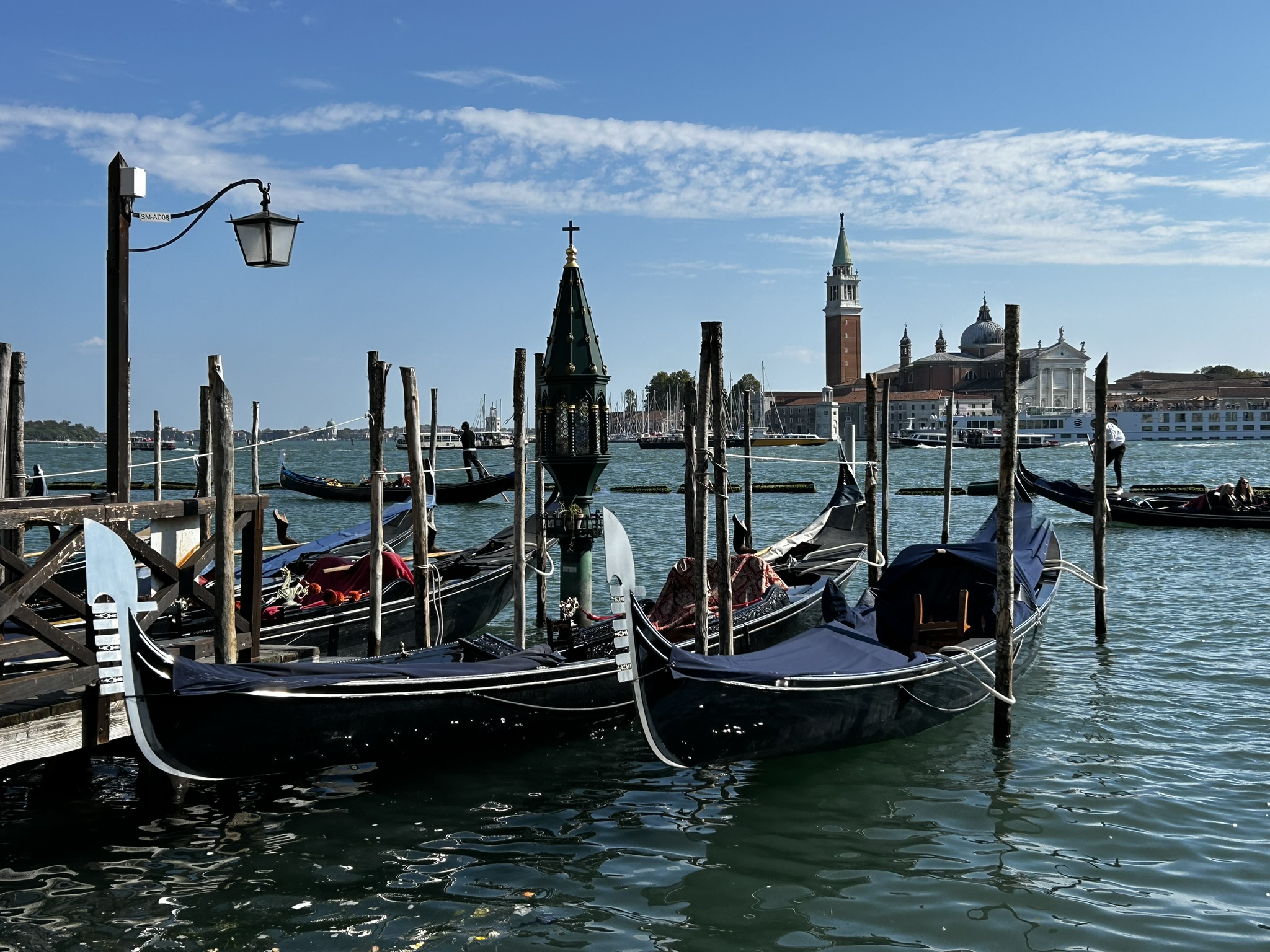
Venice is unexpectedly exciting to approach on boat. We are chugging along to a magical far away land. Towers pierce the sky. Memories of coming here on our last family holiday together in 1980, the itinerary driven by mum, the car with a caravan in tow driven as far as a campsite on the mainland by Dad. It hadn’t been a pleasurable holiday. Mum was too hot and spent every day in the shade. Early evenings beset by determined mosquitoes mercilessly extinguished by clouds of insecticide pumped out by a van that drove up and down the caravan park, campers resolutely remaining inside until the danger has passed.
This is a pilgrimage of sorts. Returning to a place I vaguely remember being a big deal as a kid. There’s a mixture of excitement, gratitude, guilt and imposter syndrome. I’ve been coming on these press ‘expeditions’ for 22 years now (the first was Eurovision in 2003). These are opportunities to discover not simply locations but people, art, and perspectives. They are opportunities to think and write better. A series of mini Grand Tours for a middle-aged man.
There was never a job advert, never really people who inspired me to do this. It just sort of happened. And here I am now. I get to do this and go places I wouldn’t otherwise go to simply because someone invites me and hosts me. I hesitate to call it privilege because I don’t think it is. It’s earned. Irrefutable evidence of a cultivated network. There is much that is unknown and that’s what makes it exciting. That I’ve earned opportunities to do things that brings me joy still seems incredible.
This reverie is swiftly subdued when I discover I’m on the wrong boat to Venice. I got the blue line when I should have got the orange line. A swift calculation indicates that my optimum stop would be Zattere with a 20-minute walk to the hotel. By my reckoning, this leaves 20 minutes to check in before heading out for the concert. Even without me planning everything to the nth degree, no trip is complete without a bit of jeopardy. That’s probably what makes it fun.
City Light and inky waterways

Everywhere there’s a charming view. It’s not chocolate box. It simply oozes the kind of authenticity you’d expect somewhere that’s been around for 1600 years. In the bright sunshine, light dances on the surface of the water. It’s difficult not to see why painters saw such opportunity. In the daytime the water is clear and inviting; at night, its inky blackness takes on a more menacing quality. Gondoliers maintain their commitment to looking good in a striped top, fitted britches and a jaunty boater, even if the hourly rate is daylight robbery.
I go to two tourist traps over the weekend. I know it’s a dumb thing to do in a way, and yet these are the things I feel this unusual pull to see.

First, the Rialto Bridge. Famed, obviously. Packed full of people on the sunny side, and unsurprisingly quiet on the shady side. I opt for the sunny side because obviously that’s where the crowd is and I want to see what they’re looking at. I don’t see the full view until I get to the middle. When I see it I gasp. The oil paintings we know of this view are based on a real life oil painting itself. An uplifting sight. There is so much story in the view, so much going on everywhere — industry and activity. It’s almost too much.
People queue on jetties to have their picture taken in front of the bridge. One woman I see poses with a bent knee and a jauntily cocked head, hair hanging over her shoulder. Her pose is framed by her partner bent double trying to get everything into the shot, both of them unaware that a massive refuse barge is passing behind heading under the bridge as the picture is taken.
Seeing what everyone sees

The following day I head to St Mark’s Square. The Bell Tower is a must. The view from the top is spectacular. A carpet of deep orange tiles top a mish mash of buildings squeezed into hotly contested spaces.
Down in the square the facade of Doge’s Palace dazzles. I end up wrestling with the gimbal capturing something that might do some kind of justice. It’s all in the edit, I remind myself. You can cover a multitude of errors by slowing things down and a few judicious cuts. It’s not before I’ve become obsessed by vanishing points all around, blissfully unaware that I spending the the hottest part of the day in direct sunlight like a proper Englishman.
When the original angle changes
I made a decision pretty quick decision not to review on this trip. This sometimes happens. You arrive, get a feel for the place, and then the questions starting popping up in your head. Why is this here? Why have I come to Venice to hear French romantic music written by composers I’ve never heard of? What coverage do they think they want? What coverage would they benefit more from? What’s the point in telling a network of experts who probably know more about this than I do, something that they’ll only judge me for not knowing before. Write something different. And take your time about it.
What I end up doing is researching a lot. Writing down endless questions. Questions lead to other questions. Interviews open up different unexpected perspectives. Suddenly, a world has opened up I hadn’t even thought about last week. It’s like discovering John Cage and the avant-garde at university, then devouring every book I could find in the library. After that, going home and taunting my parents with the weird and whacky ideas composers in the 1950s were coming up with when they were courting at village tea dances.
There are these moments then – usually when I’m on a trip – when something comes into focus. A door is opened. Lots of dusty archive boxes present themselves. An afternoon spent scanning through files and picking up titbits. It is as though I’m back at university, Seroxat coursing through my veins, possibilities still on the horizon and still very much in my grasp. I leave enriched, confident that the ideas won’t be lost and that the impact will be just as meaningful if not more so if I pause just this once.
What I end up doing is researching a lot. Writing down endless questions. Questions lead to other questions. Interviews open up different unexpected perspectives. Suddenly, a world has opened up I hadn’t even thought about last week. It’s like discovering John Cage and the avant-garde at university, then devouring every book I could find in the library. After that, going home and taunting my parents with the weird and whacky ideas composers in the 1950s were coming up with when they were courting at village tea dances.
There are these moments then – usually when I’m on a trip – when something comes into focus. A door is opened. Lots of dusty archive boxes present themselves. An afternoon spent scanning through files and picking up titbits. It is as though I’m back at university, Seroxat coursing through my veins, possibilities still on the horizon and still very much in my grasp. I leave enriched, confident that the ideas won’t be lost and that the impact will be just as meaningful if not more so if I pause just this once.