Sing to the Lord a New Song
Purcell’s chromatic daring, Bach’s furious counterpoint, Handel’s white-knuckle theatrics. Performed by the Monteverdi Choir now confidently asserting themselves in ferocious precision and a myriad of colours and textures, these works aren’t polite museum pieces but pleasing necessary jolts to the nervous system.
Purcell Hear my prayer, O Lord
Purcell Funeral Sentences
Johann Sebastian Bach Der Geist hilft unser Schwachheit auf
Johann Christian Bach Ach, dass ich Wassers gnug hätte (‘Lamento’)
Johann Sebastian Bach Singet dem Herrn ein neues Lied
Purcell Jehova, quam multi sunt hostes mei
Handel Dixit Dominus
Review
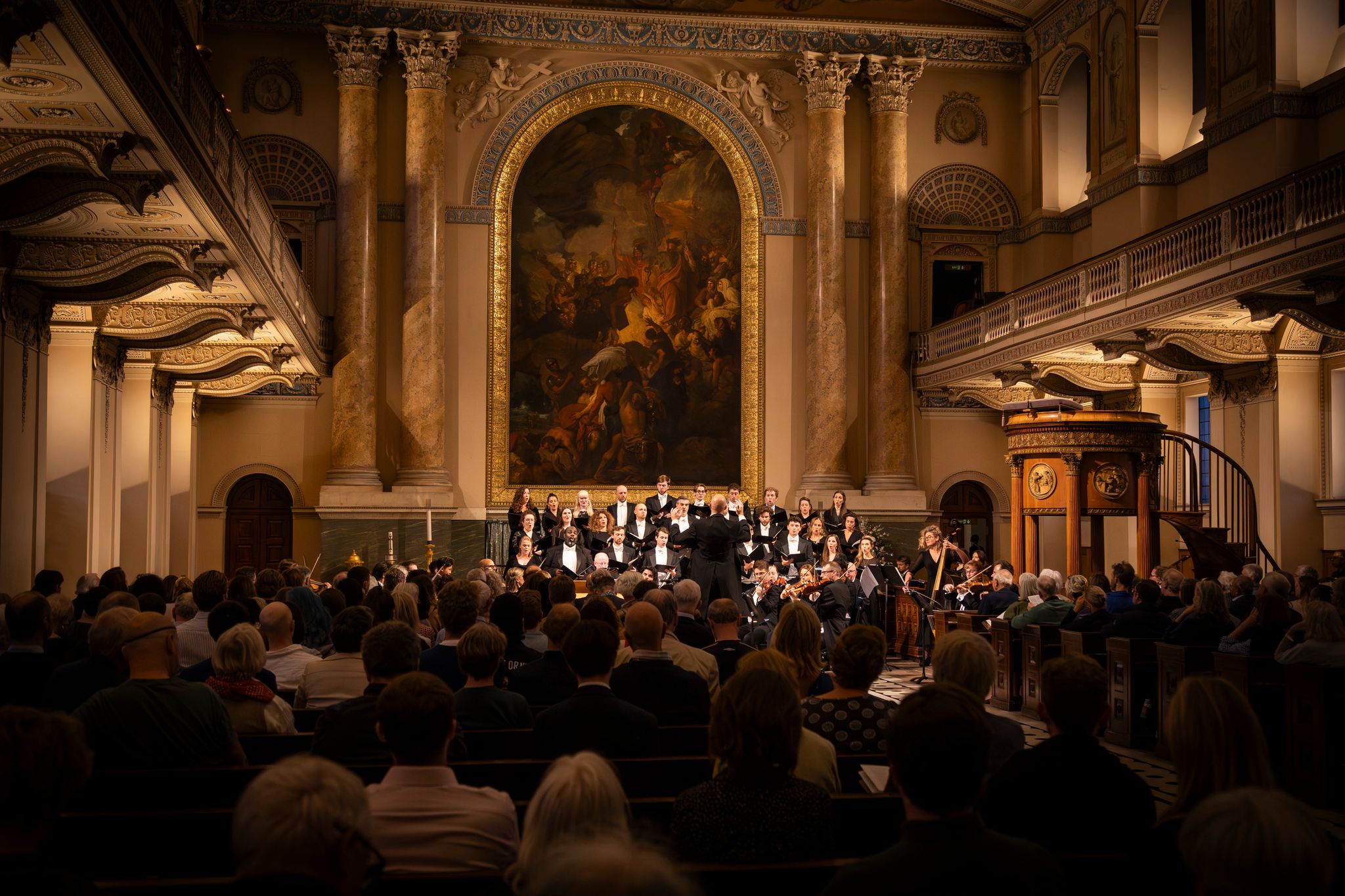
With a characteristically slow but assured pace down the nave of the Chapel of St Peter and St Paul at the Old Naval College in Greenwich, the Monteverdi Choir proudly took up its position for a final chance to hear their Purcell, Bach and Handel concert Sing to the Lord a New Song. A potently titled performance if ever there was one for the world-renowned ensemble who have, it would appear, confidently moved on from a testing time.

At the helm, conductor Jonny Sells towers above the English Baroque Soloists and the choir beyond with a wide sweep and modest gesture. The sound heard from the third row is precise, each voice bringing something distinct to create a visceral whole that judders the internal organs and, in one or two fortissimos, threatens to disintegrate the glass from the leaded windows above us. The sound is formidable. The precision breathtaking.

Under Sells, the group seems to thrive best in the music by Purcell, possibly because Hear my prayer, O Lord and a selection from the Funeral Sentences contain so many unexpected twists and turns from note to note that we as listeners gingerly hang off every single chord. Hear my prayer is an intense opener. In Man that is born of a woman, In the midst of life and Thou knowest, Lord the ensemble is remarkable, matched by the fast-shifting colours and timbres not only throughout the work but within the group. They remain, it’s confirmed only a third of the way through the programme, a magical group confidently asserting themselves. As they ought to be seen.
JS Bach’s Der Geist hilft unser Schwachheit auf feels as though it loses focus a little, and though there are moments when countertenor Reginald Mobley’s lower and mid-registers don’t quite match the ravishing beauty of the upper, the eager communication between soloist, audience and chamber ensemble in JC Bach’s Ach, dass ich Wassers g’nug hätte makes this a tenderly intimate yet wholly inclusive expression of both grief and consolation.

If there was a loss of focus in the chorus in the preceding JS Bach, then there was an undoubted return to form in the concluding first-half Singet dem Herrn ein neues Lied. Fierce fortissimos complemented nimble switches of textures and phrases of the kind heard in the opening Purcell.
In comparison to the searing chromaticism in the opening Hear my Prayer, it’s a far more conventional sounding Purcell in the opening of the second half, in Jehovah, quam multi sunt hostes mei. That these two works are written at around the same time underlines the creative genius of a composer whose life extended 35 years and still doesn’t, it feels at least, get the widespread reverence he surely deserves.

The work also proves a deftly selected preparation for the zinger to follow: Handel’s Dixit Dominus. All stops pulled out. Grand theatrics with a harder edge in music written only 27 years later, the contrast made more apparent by the programming choice. There’s tantalising detail in the orchestra, the interplay between first and second violins adding to the white-knuckle drama. Fierce basses ring out dexteram meam, after which Reginald Mobley’s porcelain upper register returns for Virgam virtutis tuae. But, as satisfying as this is, it’s beautifully overshadowed by a wondrous solo from Chloë Morgan in Tecum principium, whose sunshiney sound invites with a warm welcoming sweep that drops the jaw and widens the eyes. After a bold opening in Juravit Dominus from the chorus, Morgan returns for a magical duet with Zoë Bradshaw, both demonstrating musicianship that adapts to one another’s colours and timbres in the moment to create something enthralling and beautifully unrepeatable.
After the dazzling theatrics in Handel’s score, a perspiring Sells gently introduces a seemingly terrifying encore for the end of the world intended to send us on our way whilst simultaneously making us fear the journey home. JC Bach’s Es ist nun aus mit meinem Leben for those unaware turns out to be a gentle four-verse prayer packed full of hope, leaving some of us stunned, appreciative, and eager for the next date in the Monteverdi’s diary.
For the Avoidance of Doubt
Thoroughly Good is an independent website making the case for classical music — part commentary, part curiosity cabinet.
Classical music’s best friend, if it needed or wanted one.
Help Keep The Lights On
Support Thoroughly Good with a one-off contribution, or a modest recurring subscription.
It won’t change the world, but it might cover lunch. Maybe even a bill or two.