The very first episode of Doctor Who isn’t isn’t simply about time travel. It’s also about control, curiosity, and the fear of being found out.
This is the first in a new strand of Thoroughly Good reviews exploring television in the same spirit seen in the classical music section of the site: attentive to form, character, and what the story tells us about the people who made it.
Over the next year Thoroughly Good revisits the original Doctor Who stories – part cultural archaeology, part self-education – to see what these half-century-old programmes still teach us about imagination, storytelling and human behaviour.
Part of the charm found in the original series of Doctor Who is its sense of canon. Viewers first meet the mysterious Time Lord (though we don’t know he’s a Time Lord at this point) in then present-day London. From then on his considerable travels constructed a life of memories for us. The sense of continuity implied in this ongoing journey is comforting. Understanding the detail and appreciating the long term consequences of that only serve to deepen the connection between viewer and character. Little wonder the franchise can, 62 years later, stir such passion amongst those have invested so much in a fictional character who is also, in their imagination at least, part of their chosen family.

To watch the four episode story demands disconnecting from the stylistic norms of present-day television. This character-driven story could easily be a stage play in its exploration of leadership, influence, inter-generational clashes, and empathy. The opening episode is 24 minutes of lead character exposition – the set up for the remaining episodes. It’s stately, ever so slightly clunky, and the production values illustrate just how few lines there were on early televisions and, consequently, how much set designers could get away with.
Nonetheless, considering its scheduled slot as a teatime family drama, the opening story handles adult themes in a way that makes watching it today more of an education than perhaps it was as a kid. That’s good writing, even if the direction in what was a highly restricted space in Lime Grove studios in West London was stilted.

What undoubtedly helps here—and is likely to be in stark contrast to the fast-moving dramas we’re accustomed today—is its stately pace. Time affords us the opportunity for points to land and implications to crystallise. When they do, the messaging resonates with weight. In its opening years, Doctor Who tethered itself close to Reithian values of public service content, even though Reith himself had left the BBC twenty-five years before. Satire in the form of That Was The Week That Was had rocked the establishment the year before, but some editorial principles remained resolutely in place. Arguably, that public service connection is what preserved the stories themselves, even if the production values and dwindling budgets saw the show consigned to a dusty corner.
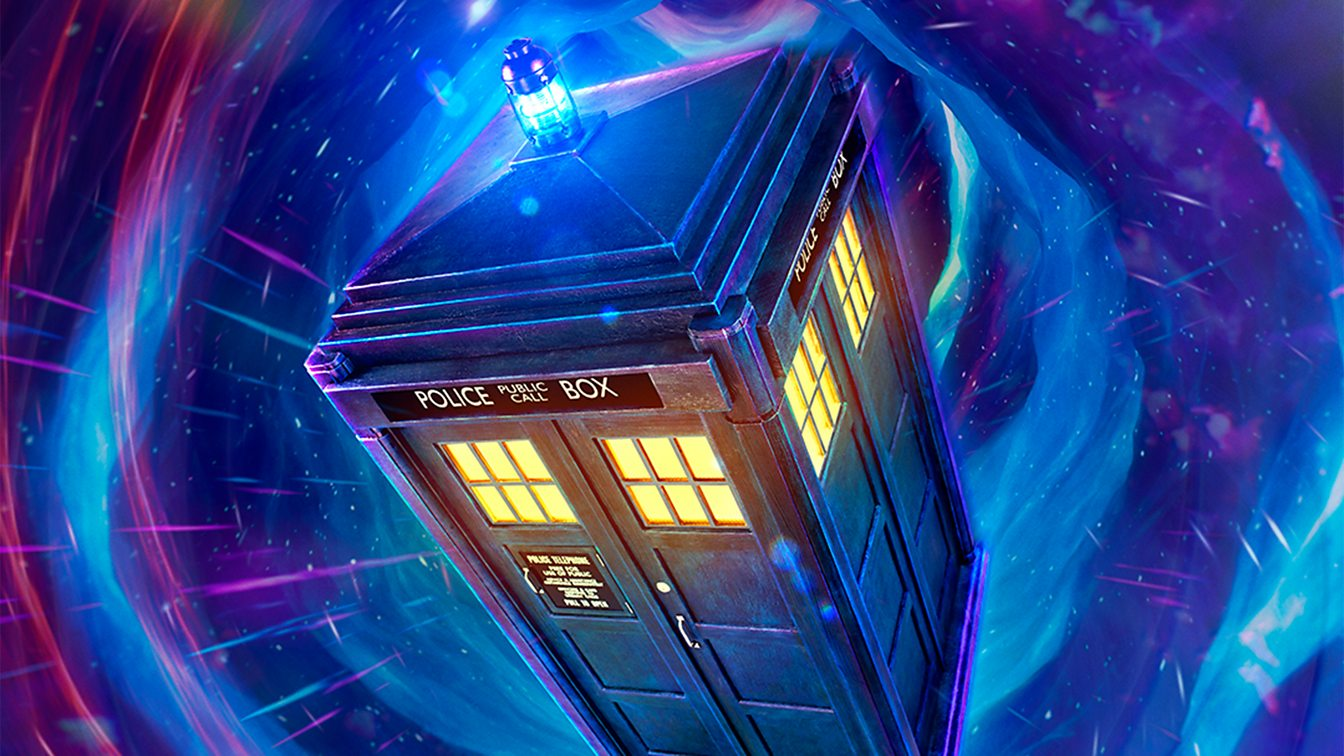
In its simplest terms, Unearthly Child tackles the challenge of ensuring variety of settings and storylines with a simple conceit dressed up in a science fiction costume. Four unlikely travellers are brought together because of a mixture of concern, nosiness, belligerence, and naivety, zipping about from one place to another, nobody entirely certain how the vehicle they’re using actually works. Consequently they find themselves in all manner of unplanned for situations, consequently drawing on their ingenuity and team work to bring about solutions that either serve them, or the underdog they’ve tethered themselves to in any particular story, or indeed both. The vehicle here is a machine that will move anywhere in time and space, one that is bigger on the inside of a battered old police box that stands in a dingy corner of 76 Totters Lane, London.
There is something quintessentially British (likely an observation fuelled by hindsight) about the premise, manifest in the iconic external appearance of this conceit. We look on the idea with derision on the DVD release twenty years ago writers Mark Gatiss and David Williams perform a comedy sketch in which they send up the entire premise as completely ridiculous but entirely acceptable. The series shouldn’t work. It also shouldn’t work because the idea seems so outlandish as to need a much bigger budget. A grubby, shanks Police Box is an incongruous outer shell for a device that can seemingly bring about such dramatic pivots, so how on earth can that work? None of this should work, and yet through solid and resolute charm it seemingly does.
Throughout the four episodes the main cast of characters adjust to circumstances in a way that collapses a more realistic timescale into four 24 minute episodes. This is one of many reasons why suspending belief is wise before watching it for the first time. Two teachers – Barbara and Ian – are concerned about the unusual behaviours of one of their pupils Susan. In a strategy clearly motivated by well-meant safeguarding concerns, follow her home, cross the metaphorical threshold of Susan’s home – the Police Box – and discover far more than they bargained for. Susan’s grandfather is more than simply uncomfortable with strangers, he displays controlling behaviours borne out of deep seated defensiveness which in today’s world would have more than a whiff of coercive control about it. The Doctor’s effective abduction of the two young teachers gets their travels underway but it also illustrates the Doctor’s fear of exposure, anticipated loss of and need to reassert control.

When they are transported back to Palaeolithic era, this unlikely and already strained group finds itself pitched physically and at times intellectually against The Tribe of Gum, whose decision making strategy is necessarily based on entirely different criteria, so too how they define who the leader of the pack is. A tussle for power emerges over who can make fire, sometimes making it appear as though it the appointment of leader that is more important than the ability to make the fire itself. In the Doctor’s group, a similar battle to assert control is mirrored in the generational wrestle between Ian and doddery, cantankerous and frequently self-centred Doctor. The Doctor regards Ian’s logical thinking and obvious practicality as evidence of him having to cede control; Ian regards the Doctor as selfish, irresponsible, and altogether unsuited. Ian’s colleague Barbara acts as the bridge, injecting empathy into proceedings which does as the story wears on distributes amongst the group.

The turning point is in Ian confronting the Doctor’s intent to kill the group’s captor in order to escape. From then on rather miraculously, trust is secured, and the group of clashing personalities starts working together bringing together different strengths and perspectives to create mutually beneficial outcomes. The group is stronger together—the very thing Ian teaches the Palaeolithic tribe is better than prioritising one leader with all the knowledge and power—one fused by a collective experience of the challenge where present-day thinking isn’t necessarily an advantage but might even be a threat for the indigenous population who just can’t understand what these beings are and so assume that they are sent by Gods in the sky to teach them how to make fire. It’s a terrible shame that the Doctor appears to have left his matches in the TARDIS, though this would have cut the story short by two episodes no doubt.

Unearthly Child is then better seen through the lens of character-driven storytelling than plot or indeed television production and certainly not, in most cases, the acting. The photogenic William Russell looks good in a head and shoulders shot, though the long shots betray his limited acting range—arms hang resolutely by his side doing nothing and the facial expressions don’t convey much more than the script. Lead William Hartnell conveys barbed irritation, belligerence and a special kind of arrogance that makes the Doctor an uncomfortable mess of contradictions that is actually quite pleasing, though at times the character sometimes presents as inconsistent. Granddaughter Susan often feels as though she’s performing a function to bring about discussion rather than being at the centre of it. Jacqueline Hill as Barbara is the actor who brings the greatest range and is, therefore, the most plausible of the lot. Fortunate too given the pivotal role she plays in the direction of the story.