How do we react when connection breaks down and our world disintegrates? We likely respond as though the world isn’t watching us.
So it is in La Voix Humaine – Poulenc’s setting on Cocteau’s one-act one-woman play. Here the opportunity to witness an intense 45 minute breakdown of a relationship news of which is conveyed by a woman’s responses to the telephone conversation in which she discovers it.
It’s an epic statement for a compact work performed by a cast of one and a pianist. There’s a lot of French (if you’re not fluent, the translation was useful), and a lot of supporting characters off stage (or on the phone) that need to be contended with.
The story is based on Jean Cocteau’s 1927 script, the manic energy of which makes composer Francis Poulenc’s use of pastiche invaluable for conveying shifting positions, fractured emotional states, and phases in the story. It moves on at pace, forty five minutes of uninterrupted music and speech flying by. Highly charged emotional flooding has this effect.

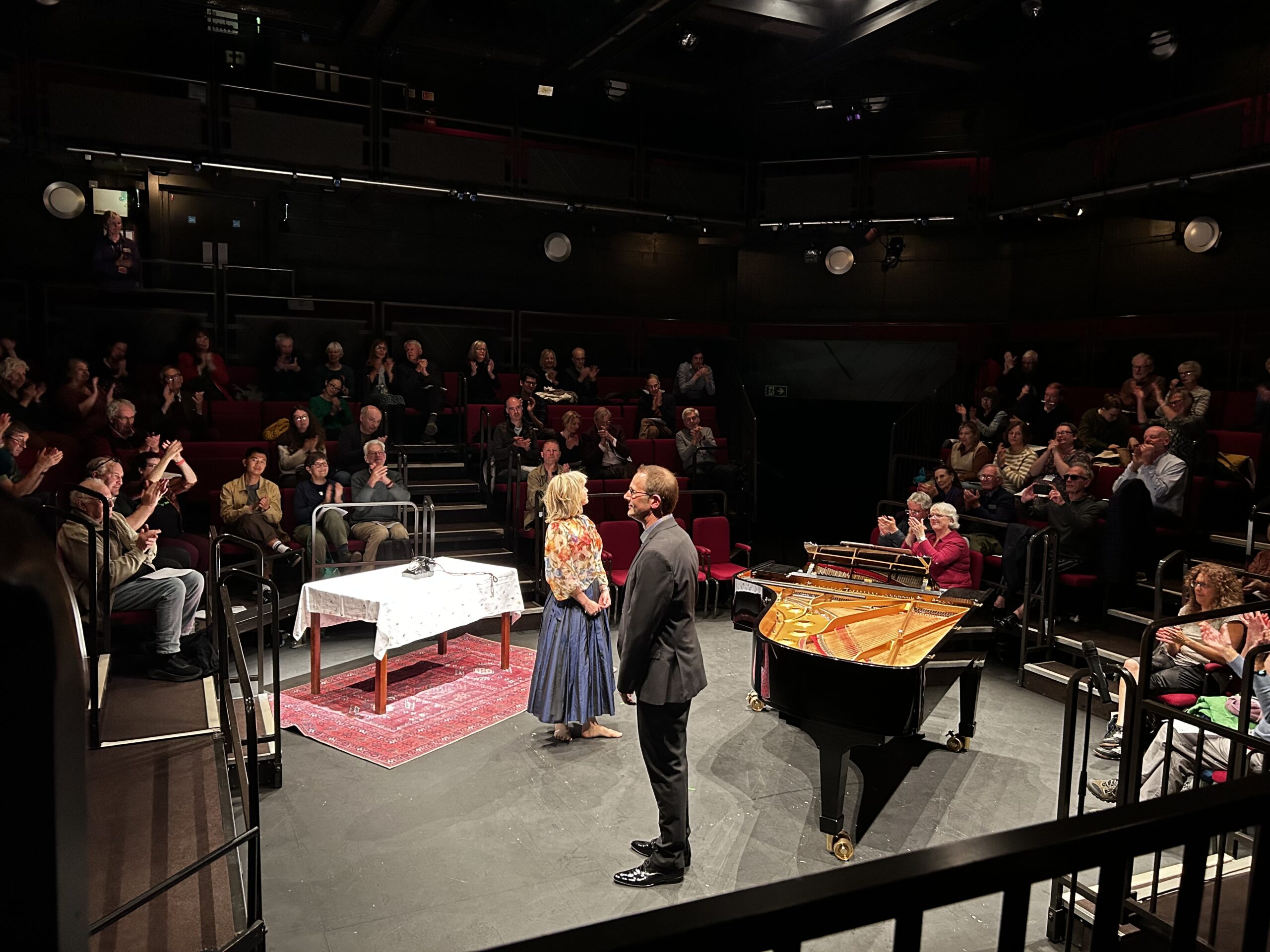
With Claire Booth we are simultaneously in safe hands and on the edge of our seats. Hers is an electric presence, steely eyes locked on to the middle distance in the bleak interiority of an independent theatrical space. The pared back semi-staging makes Elle’s gradual disconnection fraught and the situation bleak. Though for all Booth’s infectious energy there lingers more of a sense of horror than pity for the central character.
Like all good writing, we’re left wondering about the stories that try to break into the conversation between Elle and her lover, not least the one who bemoans that the conversation isn’t interesting and that she finds them both ridiculous. “But, Madam,” says Elle, “we’re not trying to be interesting …” Cocteau’s original 1927 script doesn’t seem quite so distant from present day culture when Elle sings ‘Yes. I know. I’m ridiculous, but I had the phone in my bed and despite everything, we’re connected by the phone …” The technology that helped her lover maintain the distance he needed to want to be with another woman, is the technology that brings evidence of her increasing disconnection from and isolation in the world. Nearly a century might have passed, but the cost of technological connection remains (even if it’s slightly different today).
The programme for this concert was established long before Felicity Lott’s death — the soprano died on 15 May, the news made public the following day — yet the event turned out to be a fitting tribute to a much-loved artist who had herself made her name espousing the work of Francis Poulenc. The connection runs deeper than coincidence. Lott made the role her own, and in 2013 she and pianist Graham Johnson recorded La voix humaine in its piano-accompaniment version — the first time permission had been granted for the work to be recorded with piano since Poulenc himself accompanied Denise Duval. The dispensation came personally from the composer’s niece, Rosine Seringe, as a token of friendship. To hear that same rarely-staged piano version performed live, with Christopher Glynn at the keyboard, days after Lott’s death, gave the evening the weight of an unplanned memorial. After so committed a semi-staged performance with piano, the original full-scored version may well lessen some of the jaw-grinding intensity enjoyed in this Sheffield Chamber Music Festival one-nighter.