Russell T Davies’ social issues drama series for Channel 4 is a chilling but necessary watch. RTD at his most annoying and his most brilliant.
Tip Toe is not for the faint-hearted. The first two episodes of the five-part series contain some of the bluntest exposition and character introduction in all of Russell T Davies’ output. Issues come thick and fast, each character a mouthpiece for one position or other. Two dimensional characters parrot positions in a national debate. The marginalised are still marginalised because those who fought for visibility in the 80s and 90s have got what they want and now find themselves the target for those looking to assert themselves.
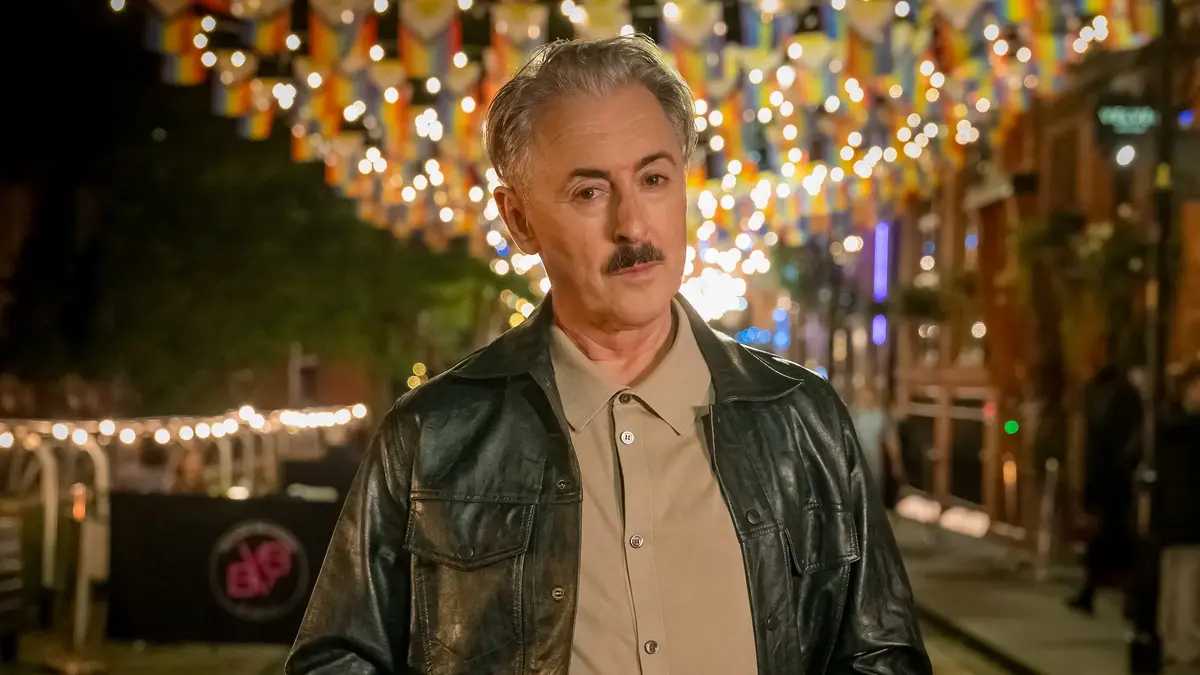
Melba (Paul Rhys) is a constant presence, sitting at the end of the bar commenting on proceedings with horrified derision – a man who’s seen it all and knows he’s about to see it all happen again, only this time a whole lot worse. Leo Struthers (Alan Cumming) owns Spit and Polish where Melba frequents, an ensemble of waifs, strays and sundry others work, play and look out for one another. Melba’s not convinced Leo sees the war that is already happening in the LGBTQ+ community, nor it seems one of the battles brewing right next door to where Struthers lives in Calico Road.
There, down on his luck, electrician Clive is quietly raging against the world he sees on his mobile phone, in his wife’s distant eyes. He’s a disaffected brute only slowly coming to terms with the realities of the Brexit he voted for, and appears to have absolutely no problem installing a key box for his next-door neighbour Leo, whose gayness is already a cause of angst for the angry parent. Even less objection to making unsolicited visits to Leo’s house when the owner isn’t there. Something his youngest son George, appears keen on doing too.

Considering so much about the ending we’re all careering towards over a ten day period is made clear at the beginning of the series, its a wonder that the drama is so compelling as it is. As the days roll on, the question is how Leo Struthers ends up hanging by a cable from a lampost. When the story finally gets moving — at the end of episode two — the horror unfolds at pace. Save for a gratuitously long sequence illustrating a point that could have easily have been made in two or maybe three seconds in episode one, the rest of the series builds a deeply unsettling kind of tension minute by minute, not through explicit depiction, instead ever more intensely.
An ever more volatile performance by David Morrisey does much of the work here. Clive slowly learns the extent to which his two young sons – one homosexual, the other raking in the subscriptions on Only Fans with live shows from his bedroom – fuels his rage. The increasingly isolated Clive has a suitable target – Leo next door – onto whom he can unleash all of his pent up rage. We all know what direction this is going, we just don’t appreciate quite how gruesome it’s going to be.

I didn’t want to like this. And yet, Davies’ clarion call articulated in characteristic reliance on stylised artifice, polished edits, and a surprisingly measured use of music, kept the pace up without allowing urgency to diminish tension, or style to threaten substance. The hypersexuality, the YA aesthetic, fetishised queer characters rising up in defiance of the oppressors, and the reliance on tragic melancholy in nearly every gay, lesbian or transgender character is in many respects a throwback to Queer as Folk in 1999. But it’s earned because the stakes are high and what drives events is simply a reflection of what’s going on now. The blunt signposting of crowbarred monologues might have derailed this.
What transpired was something closer to opera. An ensemble cast coming together for a grim reckoning in which those who were still watching were expected to take a long hard look at ourselves, our complicity, and whether or not we were prepared to look the other way. Theatre made for television that gets under your skin and leaves something incredibly unpleasant crawling around in your stomach.
It is brilliant. But approach it with caution. Less a warning about the future more a statement on what’s going on now.