Spoiler: Amanda Forsythe is amazing. Why is she not performing more in more places outside of the US?
One of the many things Academy of Ancient Music does well is storytelling. They appear to have a reliable ability to craft a programme and craft a narrative that works as well on stage as well as it does in print. That’s the band’s academic-roots for you. Oboist Leo Duarte’s programme notes do a lot of work here. Engaging, efficient, fast-moving prose, that prioritise historical detail and downplay musical annotation. The effect sees the reader and the subsequent listener placewd in the period platformed on stage. In this case, this evening at Milton Court, in 1765. A time of transition.
What the notes and the title do is present a challenge to the listener: can we detect transition proposed in print in the music we hear in performance – this supposed pivot point from baroque to classical? Or, do we see the simplistic frame generations of scholars have imposed on music history. Does the complexity and unbearableness of real life shatter the received history and reveal something far more vibrant instead? Yes, as it turns out.

Mozart’s Symphony No. 1 sounds counter-intuitively mature given that it’s attributed to Wolfgang, then only 8 years old. The programme note hedges another question with a quote from older sister Maria, then 12, who reports how she transcribe’s her brother’s composition at the keyboard. All this is in a house in Chelsea rented so that father Leopold could recover from a throat infection, listened to today here in Moorgate, just a 20 minute tube ride away, and a gap of 461 years.
Haydn’s 39 is invigorating – the first movement especially. The second movement stately; here, the string articulation is as dry and sharp as the kind of knife you’d reach for to slice through a block of refrigerated halloumi. Though the playing remained committed, the material in the third movement is comparatively dull. The fourth movement similarly so. Haydn still rocks, if we are to rank all composers in this line up.
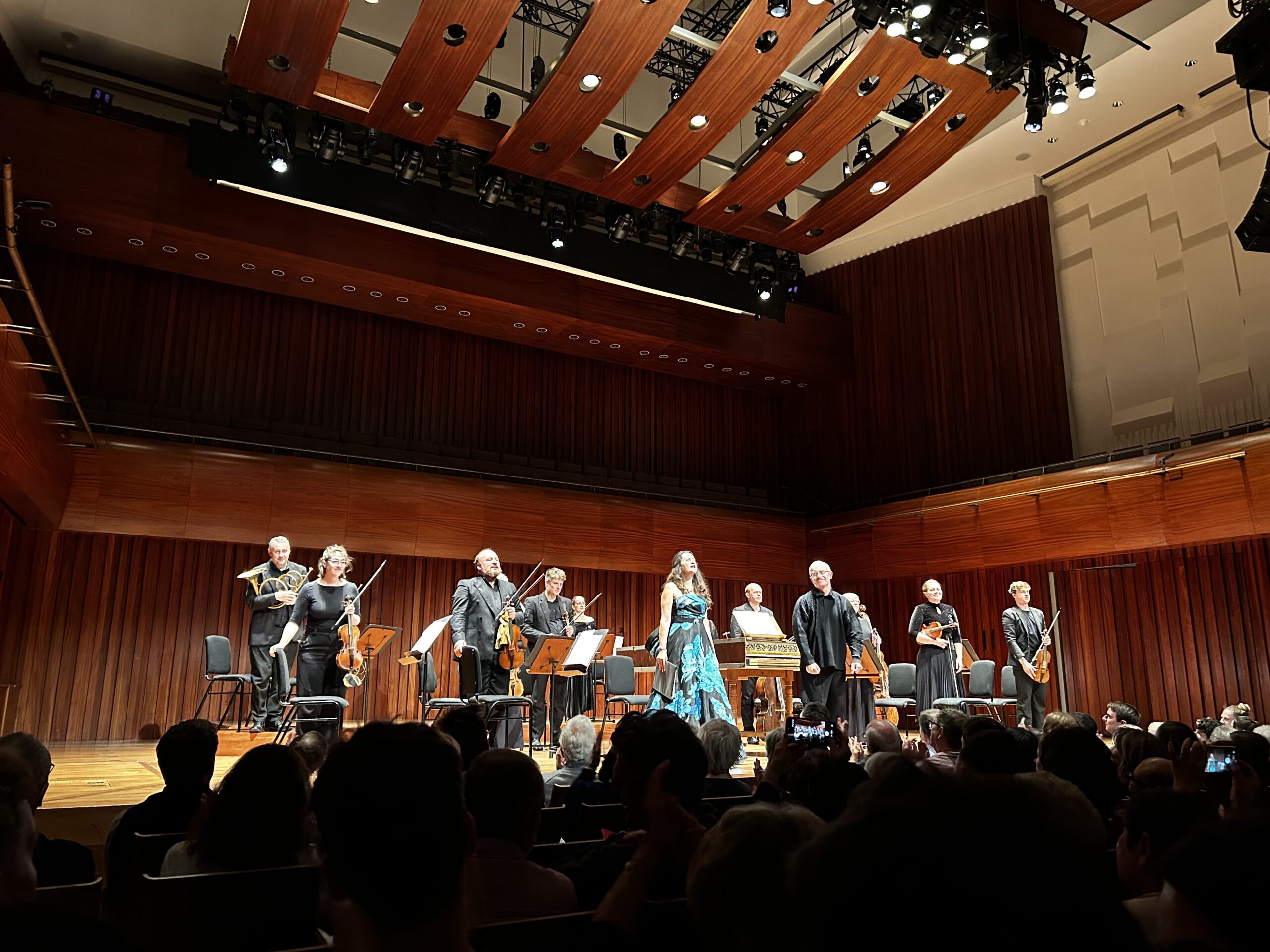
Connection in the imagination enhances connection in performance. This makes AAM’s reliably on-point playing electric once they get underway. The modest ensemble packs a punch, delivering a razor sharp line in the strings, warm plump woodwind, and smooth strong-as-an-ox horns. Combined, there’s heart and breath that elevates this juvenalia from curiosity to something far more urgent and insistent. That bit at the end of the first movement subject is still annoying the nth time I hear it, but still there’s spirit, life, and hope. This is story fuelling performance and leaving delightful residue. That’s live performance.
Soprano Amanda Forsythe pulls focus. For some of us, her warmth, clarity, and contained storytelling makes her presence on stage magnetic and bewildering. Her biog credits a career fostered in the US, including the 2026 Grammy for Telemann’s opera Ino she’s also performing tonight at Milton Court. People like me with a preference for instrumental over vocal are always going to be the tougher to convince. I leave Milton Court wondering how she hasn’t cropped up more than she has. Someone with a craft so good should surely be known more in more places and more labels? How has she slipped through the cracks?
Forsythe’s billing benefits her and and at the same time underlines Academy of Ancient Music’s lightly worn credentials. Sophisticated stuff. As it turned out, it was the first half Philidor excerpts that really commanded my attention — the ocassional octave leaps in Telemann’s comparatively earnest melodic lines revealed the demands he made on those he wrote for. If we’re being picky, you’re better listening to the finer detail in Forsythe’s craft on the award-winning CPO release.