London Mozart Players say they’re freshest of chamber orchestras. After conductor Jonathan Bloxham’s Mozart Jupiter, “refreshed” looks nearer the mark: a band powered by its strings and infectious enthusiasm, and tested by a boomy acoustic.
Mozart The Magic Flute – ‘Ach, ich fühl’s’
Mozart The Magic Flute – ‘Bei Männern, welche Liebe fühlen’
Mozart The Marriage of Figaro – ‘Crudel! Perché finora’
Mozart Symphony No. 1 in E-flat major, K.16
Mozart The Marriage of Figaro – ‘Hai già vinta la causa!’ / ‘Vedrò mentr’io sospiro’
Mozart Symphony No. 41 in C major, K.551 (‘Jupiter’)
Sophie Bevan soprano
Roderick Williams baritone
London Mozart Players
Jonathan Bloxham conductor

London Mozart Players have recently invested in their digital presence, extending an IKEA-style welcome in some of its headline copy, with a bold vision statement about it being the oldest, freshest and most adventurous chamber orchestra in the UK. It’s an aspiration that challenges the perception I have of them as a plucky, reliable group of players who deliver what people want and do so with reassuring professionalism.
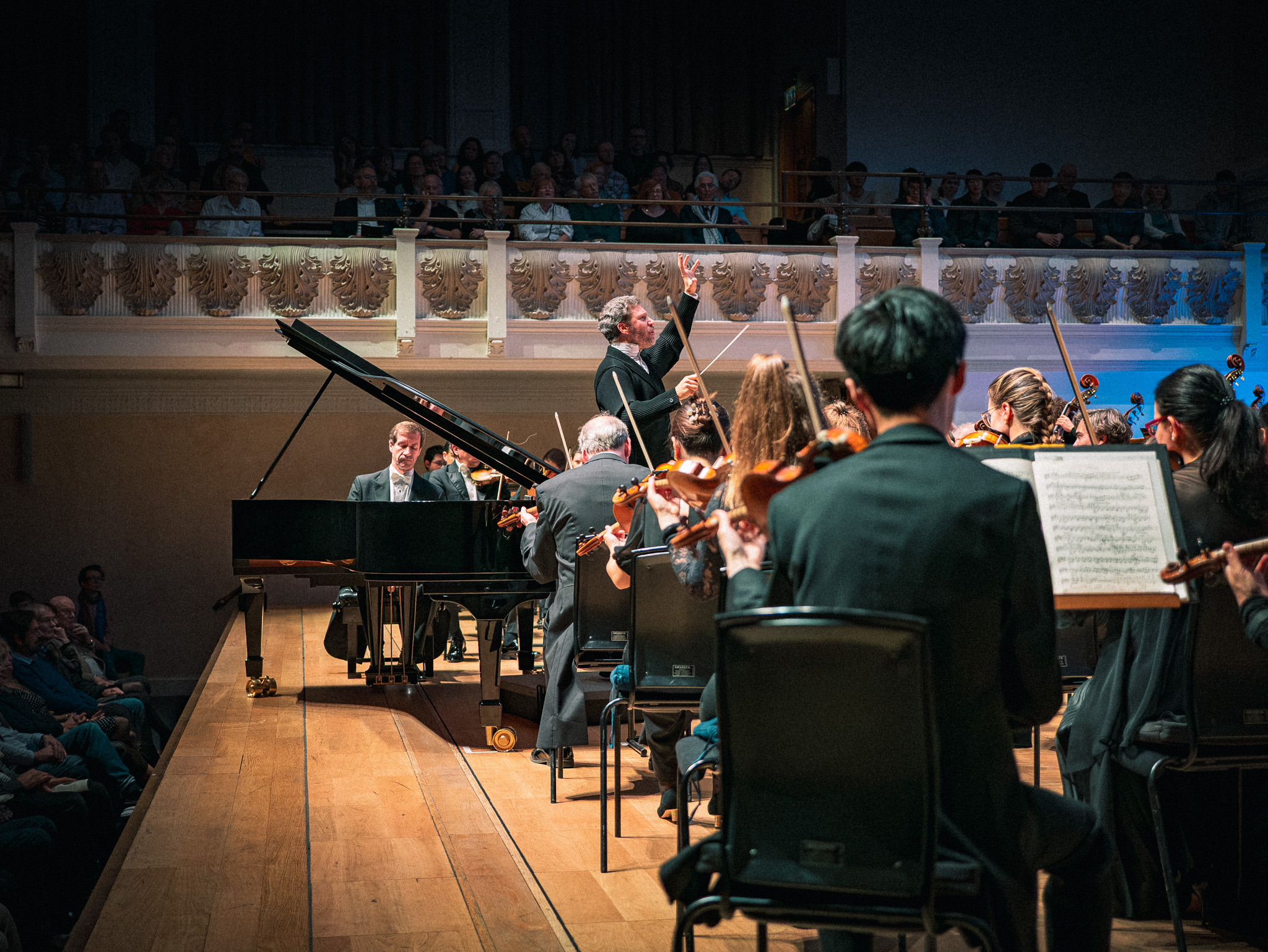
Refreshed might sit better (though wouldn’t necessarily work as effectively as a marketing line). Conductor Jonathan Bloxham, now in the fifth year of his relationship with the ensemble, clearly injects new energy into proceedings. He bounds into view, modest Nigel Kennedy vibes – more composed than the originating musician – with greying hair swept back, combining a manic scientist persona with boyish enthusiasm. Precision may slip in places, though the communication he summons and the enthusiasm he brings out in the band is infectious. Ruth Rogers as leader, does what she consistently does, maintaining the connection amongst key players with a warm smile and excited eyes. The collaboration is a delight to see up close, reflected back. You’d have to be dead inside not to feel it too.

Even from the side of the venue (I was a latecomer due to the schoolboy error of simply not reading the venue details carefully enough), that spirit was evident in the first half, even if it wasn’t visible.
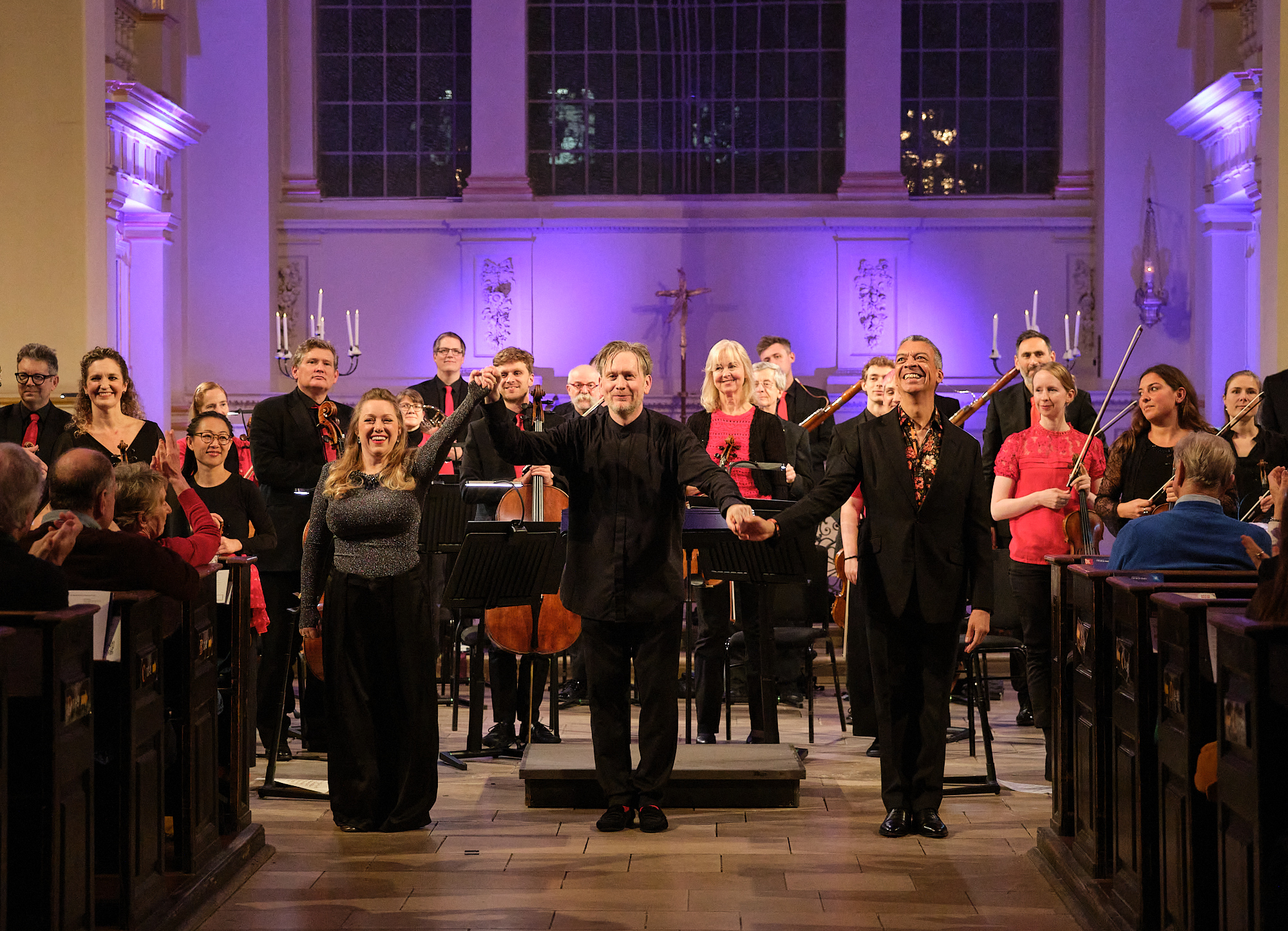
Sophie Bevan has a delicious humanity to her voice that carries well into the church, and Roderick Williams, a little less honeyed than I heard him at Snape, makes a natural partner for her. The pair blend phenomenally well, (a far cry from the comparatively disappointing partially-staged Figaro directed by Danielle de Niesse I saw in Norwich). Bevan and Williams convey character with a combination of warmth and solidity that confirms the guarantee they project on a billing with actual craft. There are moments when the drama is played out a metre or so in front of the conductor and there’s a slight struggle to maintain full ensemble with the orchestra behind them. No matter, as separate entities – voices and orchestra – they do a good job of tempting someone who would otherwise lean away from opera, to make a beeline for the Mozart on at ROH down the road.

Fifth-gear stuff with a firm grip of the steering wheel in the first movement of Mozart’s first symphony. Taut articulation in the strings and gravelly horn cues, highlight textural details that survive the boomy acoustic. Character emerges in the more sustained second movement where the seemingly simplistic cello motif that is tricky to make something of, has an unexpected hint of peril to it before it closes with a beautiful judged whisper. There is uplifting bounce, spirit and bucket loads of joy in the rumbunctious conclusion peppered with skittering strings.
Bloxham is in his element in the Jupiter Symphony, continuing the established pattern of prompt beginnings, with swift transitions between movements, a stylistic choice reflected in his spirited movement on the podium. The first movement found its footing as it went, with the narrative intent in the opening call-and-response clear, if initially a little mismatched in practice. The transition back into the repeat felt a little rushed. The second movement was where Bloxham thrived, cultivating a smooth, sweet, muted sound from sparse resources in the strings, a potent illustration of the engine that powers the London Mozart Players in its present guise: the strings. The effect was that of a warming broth, the lower strings well-measured and unfussy, with gentle bruising pedal notes in the basses. Ornamented cadences between strings and oboes misaligned on one or two occasions. Nonetheless, it was in the Andante that a darker, more reflective character emerged. In the third movement, minuet and trio all are comfortably in their stride, momentum established with a pacey tempo and all-round lightness of touch. The modest rubatos brought about between strings and oboe saw some of the finest ensemble work of the evening. The finale was joyful and spirited, though the ends of phrases from scurrying strings were lost in a boomy St Martin’s acoustic where, in the fortissimos, trumpets and timpani dominated. That is the trap the acoustic sets, one that demands a steely kind of discipline. The chromatic ‘rusty hinge’, the work’s ‘payoff’, got more of a light touch than I’d hoped for, though it fitted with the narrative arc of the work.