
Guest reviewer Caroline Potter on United Strings of Europe’s Purcell Room debut — a programme exploring music, deafness, and what it means to listen.
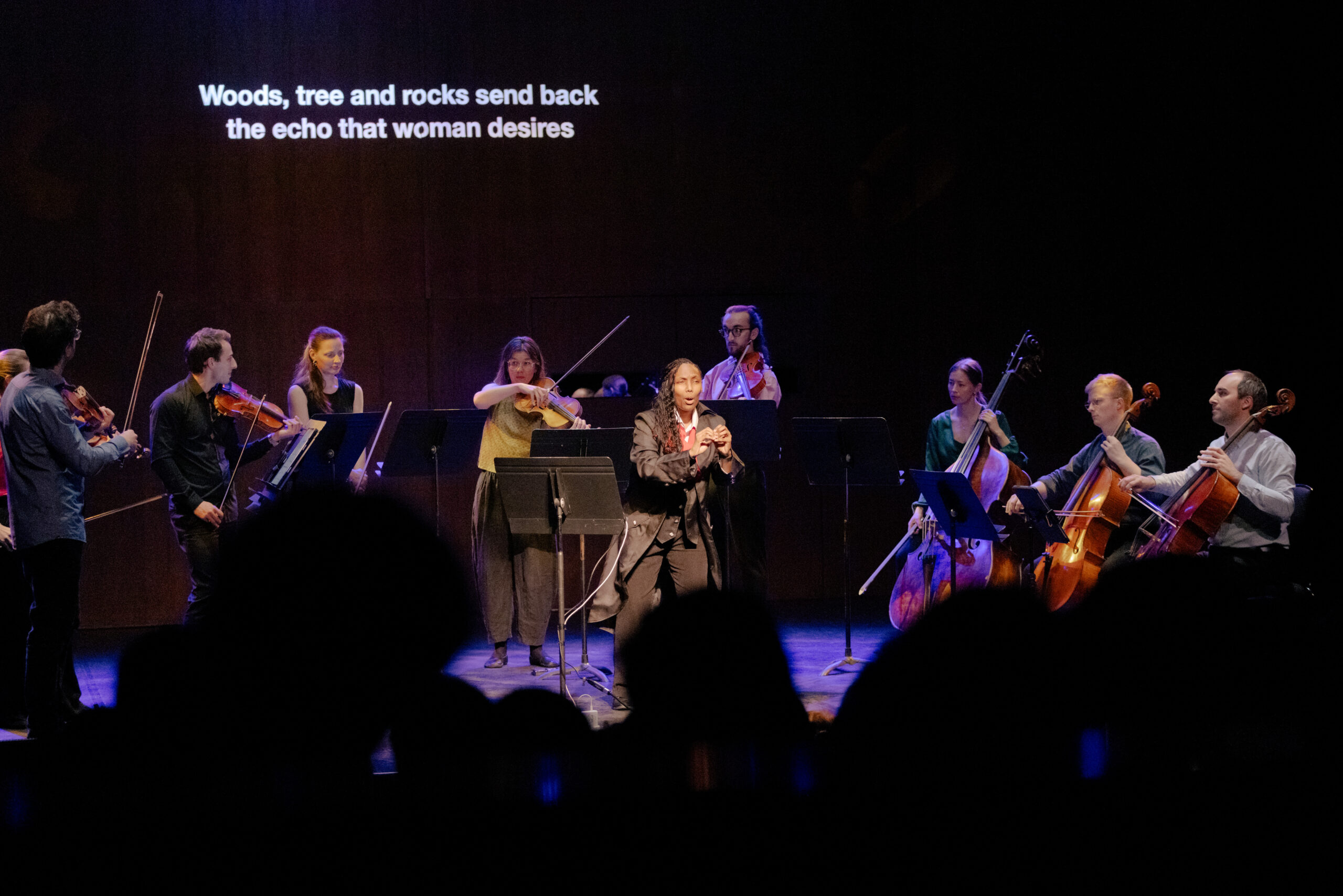
How can music be made accessible to people with hearing loss? This was the question at the heart of the United Strings of Europe’s latest show. Texts were both projected on the back wall and signed by the actor Vilma Jackson (excellent), and the music was interpreted for d/Deaf concert-goers in the hall by Kate Green. I had never seen British Sign Language interpretation of music before (didn’t even know there was such a thing) and I’d be fascinated to learn what the many d/Deaf audience members made of it.
Jessie Montgomery’s Strum was a suitably lively opener, with all string players apart from the cellists standing and projecting the lilting dance-like energy of the work. Placed at the heart of the programme, Jasmin Kent Rodgman’s send back the echo for strings and Deaf actor was commissioned by the United Strings of Europe. It was one of many casualties of the Covid-19 pandemic: it was first released online as a video and this concert was a welcome opportunity to hear it live. The text is by Beethoven and rather than being a narrative of his life, it is ‘a journey inspired by a deaf musician.’ His deep love of nature, a solace during his agonising journey of hearing loss, was underpinned by Rodgman’s music, at turns spare, fragmentary and poignantly lyrical, as if the strings were sometimes the voices of nature and sometimes a profound human response.
Gareth Farr’s three-movement suite is a USE party piece, arranged by ensemble director Julian Azkoul, which they recorded for their first album In Motion. I liked the perky titles (Mondo Rondo, Mumbo Jumbo, Mambo Rambo) and the ensemble’s dynamism and commitment made the best possible case for the work. We returned to the theme of music and hearing loss with an arrangement for string orchestra (by I-Han Fu) of Evelyn Glennie’s A Little Prayer, with text by the composer adapted, artistically re-written and performed by Jackson. The sustained chorale-like string textures were not all that striking, but the piece certainly had its place in the programme with its message about how Glennie experiences music as a Deaf musician.

The programme’s journey aptly ended with Beethoven himself, an arrangement of his String Quartet in F minor, op. 95 by Azkoul. Sometimes reduced to a quartet of soloists (Azkoul, Ariel Lang, Kay Stephen and Raphael Lang) and sometimes a full ensemble, the USE captured the intensity of Beethoven’s work without sacrificing its intimacy. On the surface, its expansion for string ensemble might seem a pointless exercise, but the finesse and precision of the United Strings of Europe added a new dimension to Beethoven’s quartet that was entirely convincing.
Beethoven’s presence reminded us that hearing loss need not be a barrier to music-making at the highest level. The United Strings of Europe and their collaborators challenged us through their music, not just through words, to broaden our perceptions about how people experience music. The concert showed how to do inclusion in music with artistic excellence and accessibility working hand in hand.