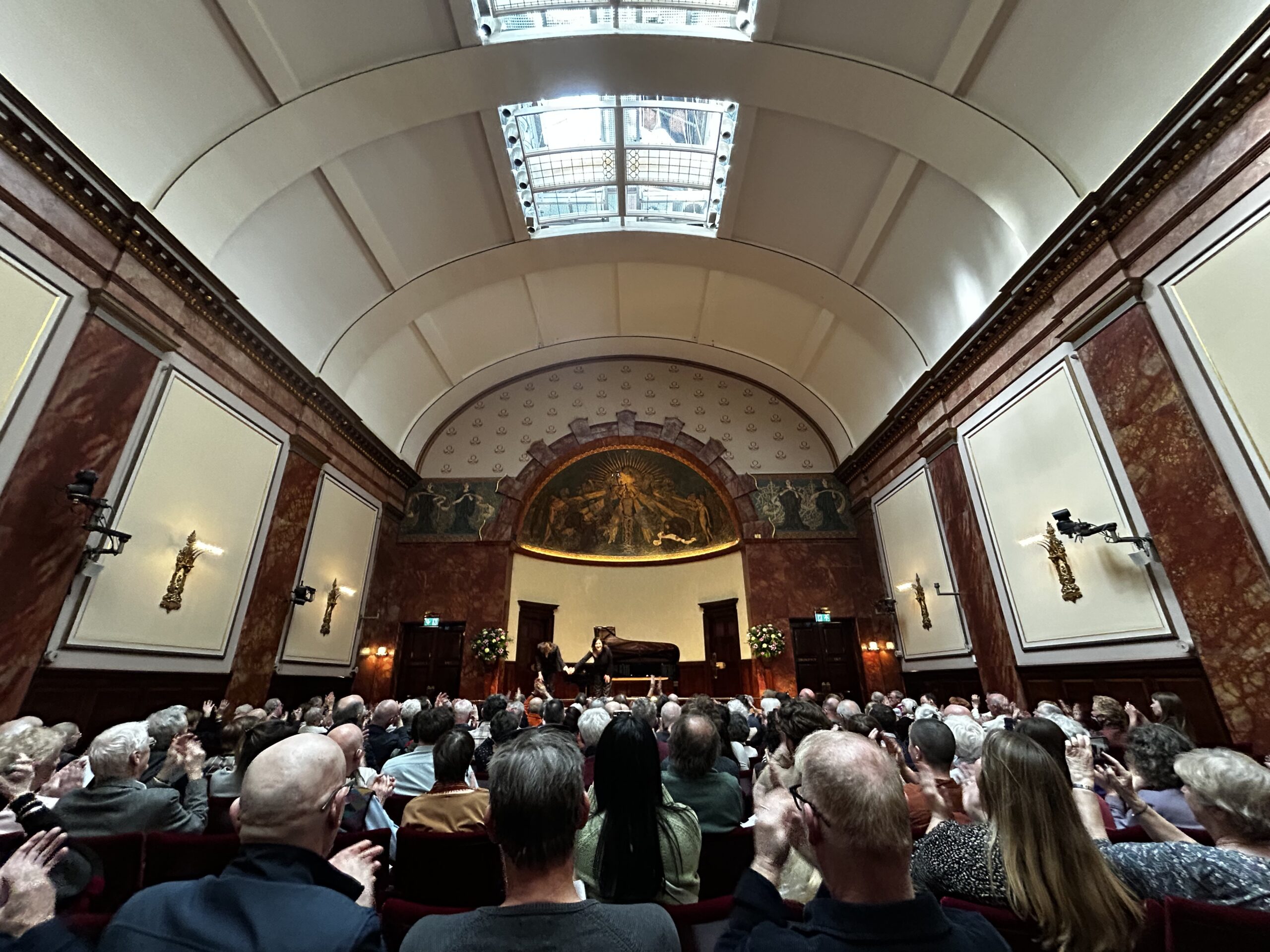
Wigmore Hall Song Competition winner Beth Taylor and pianist Hamish Brown’s afternoon programme had the sea running right through it, and highlighted a composer’s name to follow.
Cameron Biles-Liddell contrasts evocative images of the sea in his work The Breakers, setting text by two late-Victorian poets — all peril and exposed shoreline in EH Brodie’s The Storm and moonlight skittering across oily-black water in William Sharp’s Twilight. Both poems practically do the composer’s work for him — they’re so vivid and concrete in their imagery that they almost demand a certain kind of setting. The interest then is in what Biles-Liddell does with that invitation: not just whether he responds to it, but how deliberately and distinctively he does so. Biles-Liddell responds to with a clear architecture, invention and control rather than straightforward word-painting, sidestepping the trap the texts set. In The Storm the score makes full use of the piano and in particular Beth Taylor’s remarkable vocal range, her transitions between upper and lower registers more supple in Biles-Liddell’s work than in the My Lagan Love that opened the concert. William Sharp’s Twilight was a moving evocation. Not a breath, not a sigh was contrasted with decorative motifs that seem to dance on the piano. Similarly, delicate staccato patterns ripple in the upper register above a deep suspended bass line evoking an eery depth that is paradoxically comforting. Harmonically Biles-Liddell deftly treads a fine line, drawing on present-day influences of soul and musical theatre, at the same time as establishing a distinctive voice. Two contrasting settings, yes. One consistent quality: clarity that makes compositional choices identifiable. My disappointment is that I’ve not been able to get to his other premieres these past twelve months. There must surely be more to come.

The afternoon closed with Edward Elgar’s opus 37 Sea Pictures. Dame Janet Baker has made the definitive recording of the work back in the 60s, and consequently made the work impossible for any other singer to occupy since. Elgar’s resourceful invention is evident in the piano and voice setting more readily than in the orchestral setting. Beth Taylor draws on rippling rubatos in ‘Sea Slumber Song’, blissfully smooth octave leaps, and a dark low register for shadowy sand, echoed in a low piano line for the elfin land. The joyous sea-swept whisper ‘In Haven’ has a calming and comforting effect. In ‘Sabbath Morning at Sea’, Taylor’s precise articulation is matched with a precise warmth in timbre, contrasting fragility with a full-throttle declaration in God’s Spirit give comfort. Similar delights are found in the precise and evocative diction of ‘Where Corals Lie’. Elgar leaves the words of Adam Lindsay Gordon’s ‘The Swimmer’ to do the heavy lifting, notably in the line On shallows sheeted with flaming foam. Sometimes the most powerful choice is to step out of the way and not complicate things. Both Beth Taylor and pianist Hamish Brown resisted the temptation to overplay the setting either. Janet Baker’s recording sets an impossibly high bar, but Taylor meets the challenge not by competing with it but by understanding what the music actually requires: restraint.