We came for Schubert. What we got was something rarer.
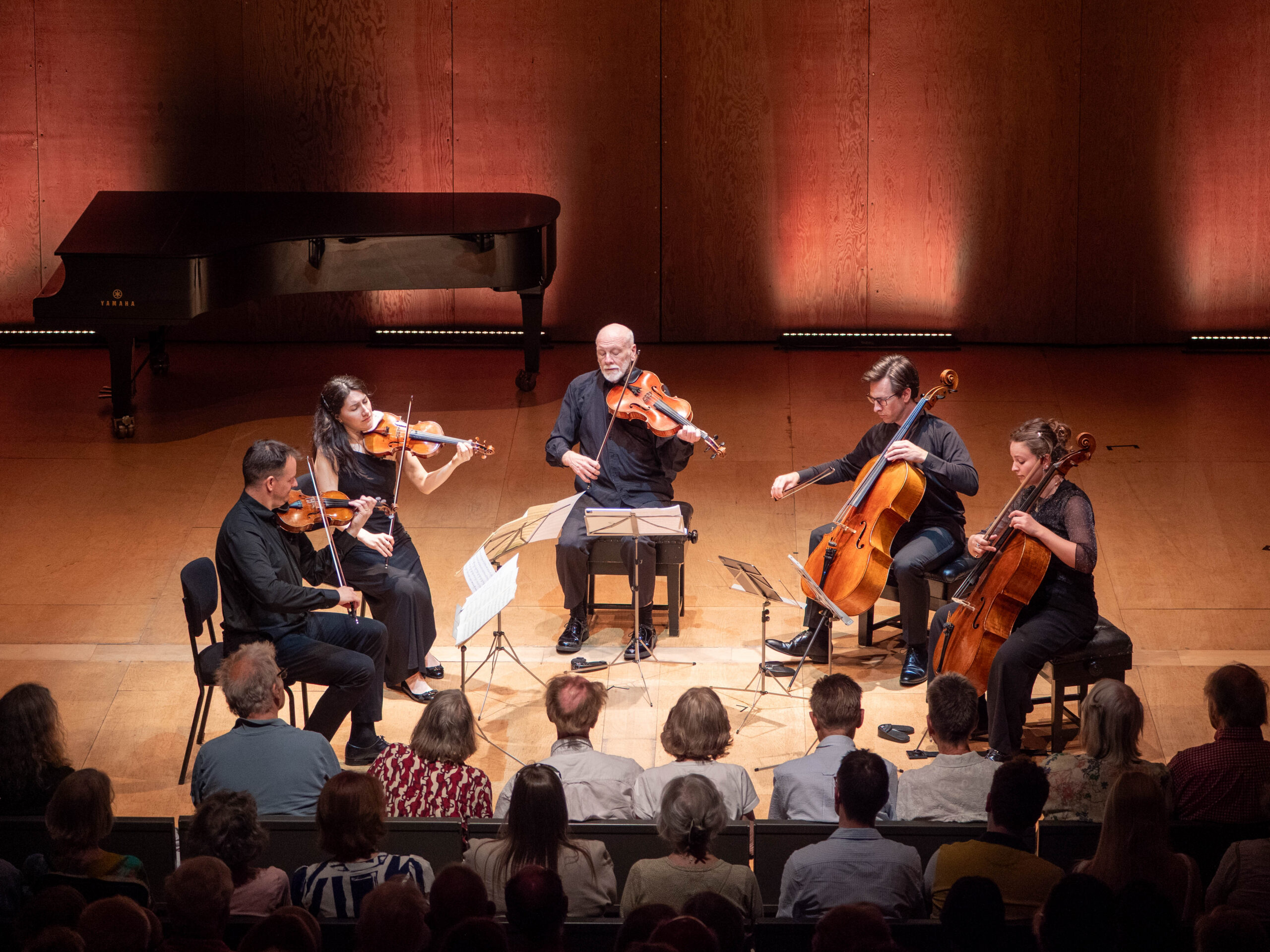
The capacity crowd came for Schubert, perhaps unaware of the impact this quietly billed line-up of players were going to surprise us with. This was the first of two concerts cellist Guy Johnston would give that day. Joining him at the Britten Studio was cellist Laura van der Heijden. Both followed a similar path to professional visibility — Guy Johnston winning the BBC Young Musician in 2000, later a judge on the panel for the 2012 competition in which Laura van der Heijden secured the top prize at the age of 15. Violinist Magnus Johnston, brother of Guy and usually seen leading the Royal Opera House Orchestra, here took first violin; Irène Duval second. Her list of collaborations — Argerich, Kovacevich, Jean-Efflam Bavouzet, Joshua Bell — speaks to the high regard she has already secured early in her career. At the heart of the ensemble, composer-performer Brett Dean. A composer of Dean’s standing might reasonably be assumed to lead with that identity in performance. Not here. His chamber music credentials were considerable — and, once heard, self-evident. This group of slightly difficult to fathom connections is a gratifying collection of diverse ages — inter-generational collaboration mixing youthful exuberance with maturity devoid of cynicism.

With Dean at the heart of the ensemble in a stark interior of warmly lit wood, everything was visible — musically, thematically, dramatically. Players appeared as though they had arrived with energy that needed releasing judiciously, lest it overwhelm. This measured release is disciplined, considered and intentional. As a result, focus rests easily on those moments when material switches from one pairing to the other, or between registers — following the score without one to hand becomes an instinctive and deeply rewarding listening experience. The opening subject is operatic in feel — a vocal declaration transcribed for strings. Every time it returns, something has been adapted in colour or intensity. We conclude on something rusty — vivid in colour and texture. Tactile, sophisticated, modern.
The opening of the second movement holds the tension we’re left with at the end of the first, though the emotional direction takes a different tack towards loss. It’s a captivating performance, all five holding character and emotion jointly, making the direction of travel clearer. Magnus Johnston glides — the articulation distinct but unfussy, glossy, bright and full, sunny with a gentle cooling breeze. Later, the ensemble creates a notable stillness in the room; the silence between notes stops breath. This is instinctive playing underpinned by focussed listening. It left the room suspended — as though returning to ordinary time required a conscious effort.
The Scherzo offered release — joyous and propulsive, everyone letting rip, though the harmonic variants beneath kept it from tipping into mere lightness.
The fourth movement captured a folk dance feel — less chamber music, more music for a town gathering. An idyl, characterised by rubatos that didn’t linger but created the human element. The contrasting section had a feel of Dvořák about it. When the opening material returned it was more emphatic, as though self-assured, powered by stronger celli and viola. Dynamic contrasts sharper, more noticeable. More solid.
Throughout, but perhaps most evident here, Laura van der Heijden appeared in her element, casting around to share the joy though this wasn’t always reciprocated. The communication may not always have been established with acknowledging smiles, but in the precision pairing of instrumental lines — the skittering staccato between Johnston’s violin and van der Heijden’s cello a particular case in point.
The real discovery is Magnus Johnston — unshowy authority combined with a glossy, self-assured tone. There is something appealing about someone who would normally be invisible in the pit given his moment in the sun. We should see him more.
Come the concluding sequence, a build from quiet resolve into something courageous, bold, and joyously defiant. This was the unequivocal sense in the room — whatever the programme notes suggested about Schubert’s ambiguous ending, this ensemble answered it not with resignation but defiance.