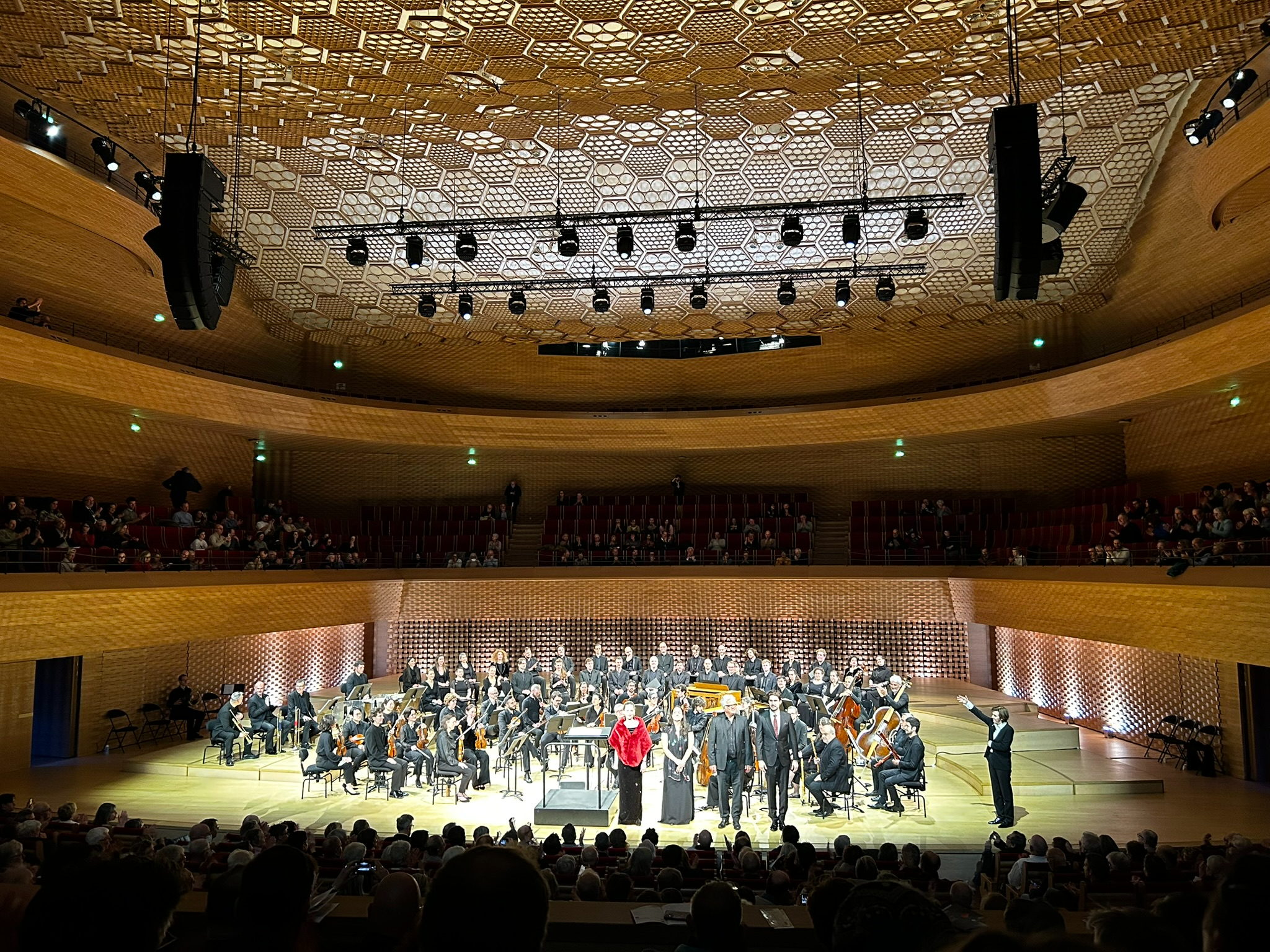

Equilbey’s first public encounter with Bach was brought to life with care and precision — the Accentus and Monteverdi choirs, principal voices and instrumental soloists combined into something underplayed but never underpowered.
Mastering the acoustic made the venue a critical part of the chain. There was a sense that different sections of the ensemble were being carefully controlled in order that the decorative elements of the writing could do the work in lifting the soul. This wasn’t simply about using dynamics, but holding dynamics back in order that the detail could be heard.
In the private reflection, instruments and voices combined to create a cohesive whole. Flutes and soprano Núria Rial’s timbres dissolved into one another, indistinguishable and comforting. Oboes brought both warmth and agitation to Anna Lucia Richter’s mezzo vocal line that was naturally accommodating and settled, the tension between them productive rather than uncomfortable. In the bass solo, the natural horn added a rawness that carried the vulnerability in Gerrit Illenberger’s vocal line. Underpinning this, a balletic double bass line drove momentum with sharp textures and strength that gave the work depth and propulsion.
Wobbly moments during the opening of the first solo where ensemble, oboes and voice jostled to settle on the pulse, were quickly corrected almost imperceptibly. Later, delicate cadences exposed the detail in the writing, demonstrating forensic direction from the podium and focussed listening across the stage.

The Et incarnatus est stopped the pen on the page. A pedal note sustained above which expansive legato lines in the voices and clipped articulation in the strings created an almost unbearable tension, the kind that halts the breath. The final cadence delivered not so much a resolution but a suspension, as though the music had insisted there was unfinished business to attend to. The Crucifixus that followed offered a deferred release.
Equilbey maintained her characteristic modest style of direction throughout, unfussy in gesture yet precise in result. The effect was cumulative, not declarative. A subtle strategy implemented determinedly. The Benedictus arrived like calm after a thunderstorm: Güra’s authority intact, his vulnerabilities acknowledged. The Agnus Dei completed the arc with a measured resolve.
A week of rehearsals for the combined forces of Accentus and Monteverdi Choir saw the chorus anchoring the work, nimbly adapting to the energy required at any given moment. Their sound was powerful but never overworked. Articulation was relied on far more than dynamics to bring about intensity. Though the tenors on their own occasionally felt underpowered, what mattered more was how all — singers and instrumentalists — adapted so readily.
Equilbey and the forces on stage created a collective experience that supported individual reflection. At the same time, they created a listening experience that felt like a live recording of a much-loved interpretation, such is the reassuring attention to craft all on stage, committed to. Insula, Accentus, Equilbey and the Monteverdi Choir are a powerful combination. More audiences in the UK deserve the opportunity to hear them.
Insula Orchestra, Accentus and Monteverdi Choirs continue their European tour with Bach’s B Minor Mass on 27 March at La Seine Musicale, Paris, 4 April at Auditorio de Cuenca, Cuenca, 7 April at La Halle aux Grains, Toulouse, and 9 April at Concertgebouw, Amsterdam.