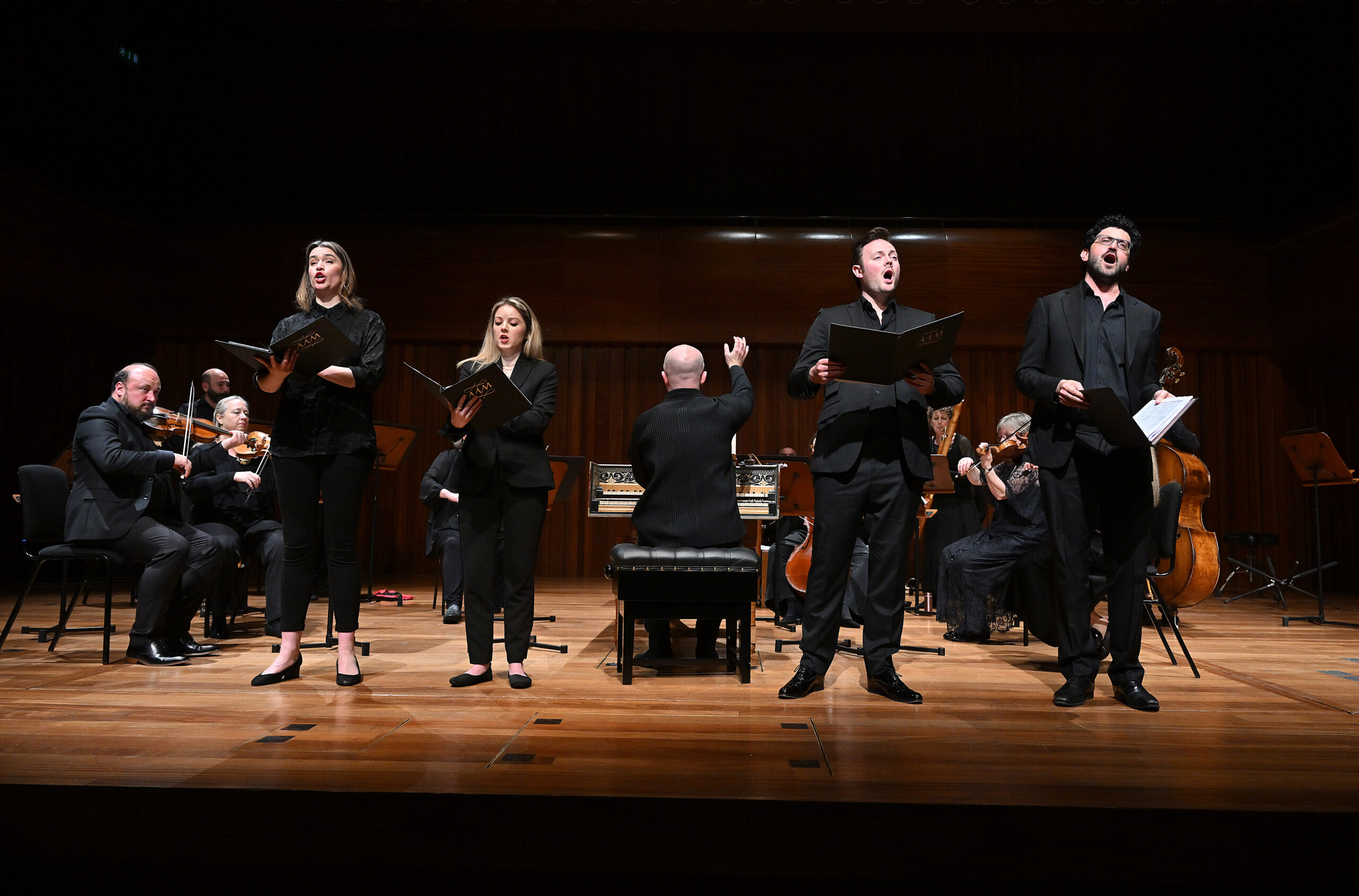
Academy of Ancient Music’s part-historiographical study, pinned to musical exploration, exposed the nearly always-overlooked route to JS Bach’s appointment as Thomaskantor, posing one delicious counterfactual question: what if Bach hadn’t got the job?
Soprano Rowan Pierce joined bass Ben Kazez, tenor Nick Pritchard, and alto Helen Charlston in performances of works written by the composers in the running for the role, beginning with the first choice, Christoph Graupner and ending with the last man standing, Bach. This ingenious programme presented material weaker than Bach’s, making hearing Bach’s actual audition cantata BWV 23 Du Wahrer Gott und Davids Sohn, at the end, a comfort earned partly from the endurance of listening to less cohesive settings.
Pulling against the ingenious editorial hook — a ‘look what you could have had’ style of compare and contrast — were the logistical demands of performing relatively unfamiliar scores. Lesser-known repertoire needs performers who can make unfamiliar material persuasive on its own terms, not merely contextually interesting. More rehearsal might have been needed to mitigate this. There is a further tension here: the programming choices that make the contrast with Bach most stark are precisely those hardest to bring off in performance. The unfamiliar made us hungrier for Bach — but it also made the journey there harder work than it needed to be.

Some of Graupner’s Lobet den Herrn, alle Heiden would have benefited from a greater attention to balance in the Milton Court auditorium, favouring the vocal lines rather than the orchestral accompaniment. The Telemann cantatas were solid, though where the material flagged, there was a sense that the energy on stage dropped. Telemann’s chorales aren’t as convincing as Bach’s, and in places the melismatic lines in arias, though decorative, felt overworked. The Fasch concerto was more interesting material, though at times there was a sense that the ensemble lacked cohesion. The melancholic second movements resonated warmly, but a lack of gritty edge held the outer movements back.
It is in GF Kauffmann’s O ich elender Mensch, wer wird erlösen that more interesting material was heard in the first half of the concert. In the alto and chorus aria, the performance was stronger and more assured than anywhere else in the first half. In the bass and alto recitative that followed, Helen Charlston pulled back focus with taut clarity in her voice, shining later with an agile octave leap in the line Allein, wie lange soll ich.
On balance, the difference in musical language and textures brought about by these programming choices likely works in the performers’ favour. The switching between styles lowers performance expectations — this was never about precision so much as the gist. We focus instead on material contrasts (and similarities), making the resulting concert intellectually engaging if emotionally uneven. Graupner’s orchestral accompaniment is denser than Bach’s. Telemann strives for a lighter ‘citrussy’ feel with high, sharp-edged strings and a lighter, more delicate texture. CF Rolle’s Es wurden aber auch and Verdammliche Bosheit from St Luke’s Passion present a more instinctive melodic style, though the composer’s use of contrasting treatment rather than harmonic development makes his material feel comparatively unsatisfying.

That Bach’s appointment came after Graupner’s release from his employment by The Landgrave of Hess-Darmstadt and the withdrawal of all other candidates from consideration made this a pivotal moment – the editorial heart of a concert in which some of the music failed to stir. When it arrived, BWV 23 reached into my soul and gave it a hug. We marvelled not only at Bach’s rich counterpoint, but also at how Bach’s fingerprints were already visible in his rivals’ work. The fragility of how Bach came to prominence is underlined both by the onstage storytelling and by the thorough and engaging programme notes that accompanied the concert. A world without Bach’s music seems impossible to imagine, and more of a possibility were it not for a sequence of events that led up to his appointment as Thomaskantor, and in the revival of the composer’s music fifty or so years after his death.