Opera helps us take some of the political heat out of it” — Dominic Sandbrook, reflecting on his first libretto, accidentally hands the audience the challenge with Mrs T.
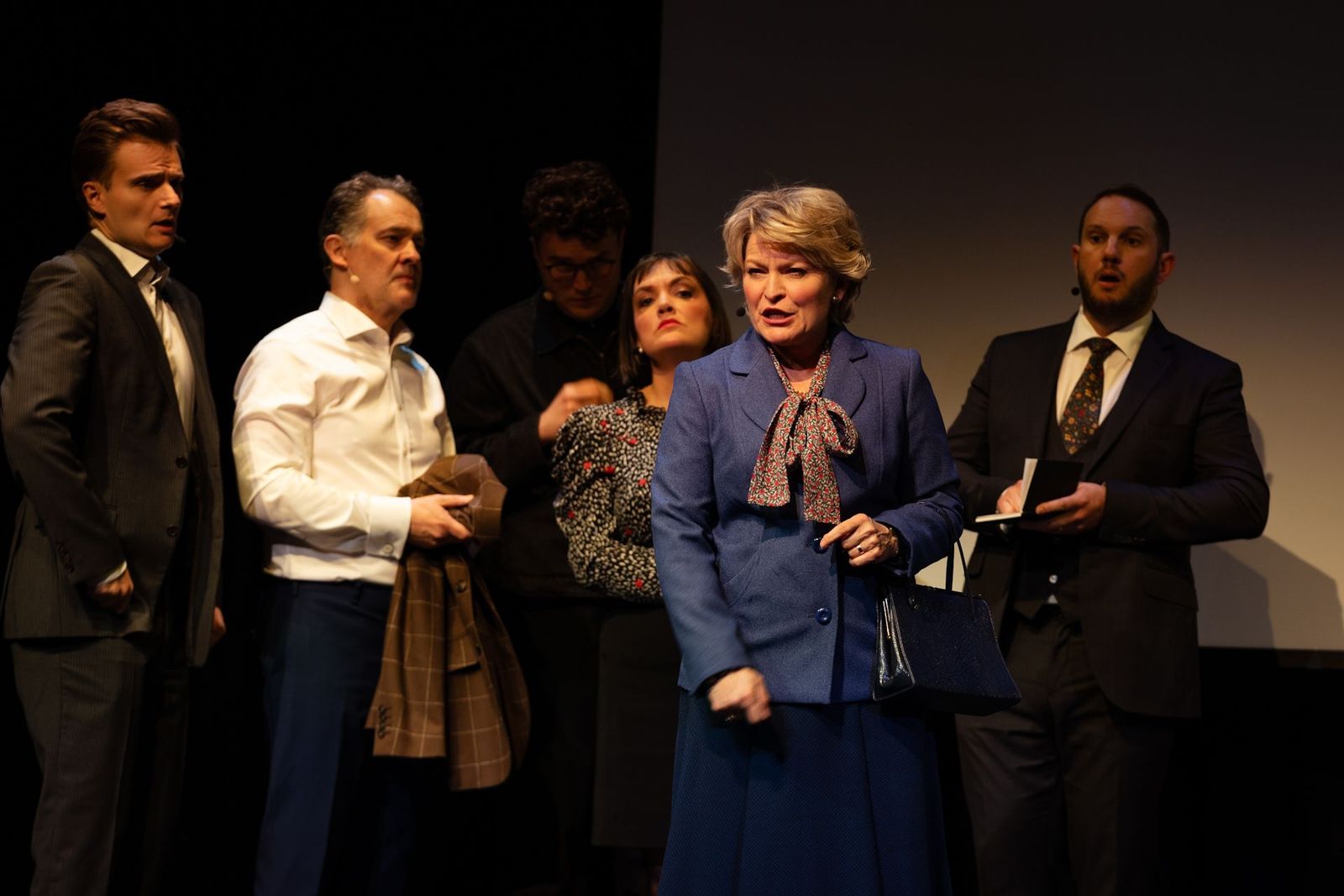
Caveating can have unintended outcomes. Director Lucy Bradley mentions four times in the space of 90 minutes that what we’re watching on stage tonight from the first half of Dominic Sandbrook and Joseph Phibbs’ new opera Mrs T is very much in research and development phase and is seen tonight after a very short run of rehearsals. The considerable energy poured into hyping the preview might have risked draining away had it not been for Lucy Schaufer’s performance. The character is plausible and will undoubtedly develop further. Schaufer’s Thatcher has elements of the determined matriarch, but with moments of warmth that belie the hard edge many recall of the former prime minister. A larger performance space and a live score will add the grandeur and import. It needs to.

Sandbrook’s libretto is leaden, clunky, at times conjuring an end-of-term musical vibe. There’s a sense he’s aware of it too. We’re reminded in both the introductions from the stage and in the Q and A moderated by Sandbrook’s Goalhanger colleague Marina Hyde that Mrs T isn’t about the politics but the personalities, though one wonders who in the room really believes the two really can be separated. This get-out clause for Sandbrook is underlined by him saying he’s ’blown away’ watching it on stage, and his repeated declarations of his fraudulent status as librettist (if you’re contracted to do the job, own it – enough with the performative humility). Panellists and audience giggle when Hyde gently refers to Thatcher as a divisive character: “We probably wouldn’t take this to Barnsley,” quips Sandbrook. I want it to succeed – Schaufer’s ongoing investment in the work, whether opera or musical theatre – deserves a handsome return. Schaufer and the rest of the cast deserve more than being asked by a moderator if she believes Thatcher was a diva like soloists in opera. Such a mismatch damages the credibility of the product.

Something else doesn’t sit right. More people than was comfortable laughed at Thatcher’s line to Reagan, “I’ve never had so much fun as when I beat the steel workers!” Who are we laughing at? Thatcher for being so witty (not a characteristic usually ascribed to her), or are we laughing at the plight of the steelworkers? Either way it feels oddly tin-eared. The line is not only in for laughs but gets them. So, Sandbrook has found his crowd – people who respond warmly to the idea of opera but have little time for art. Elsewhere in the preview, a more daring writer would have resisted simply depicting opposition to Thatcher with verbatim chants, and told the human story of those whose lives were upturned.
In Mrs T the audience is invited to regard Thatcher in more forgiving terms, borrowing the narrative Spitting Image exploited in the 80s of the woman sorting out the ‘weak’ men, but now looking at it through the present day lens of bias and gendered language. Thatcher is heralded when you look at her as a personality ungratefully brought down by her work husband Geoffrey Howe. The narrative was present then, what’s different now is the lens which focuses on the personality not the politician.
To look at Thatcher the personality without the politics is to wilfully overlook how the politics shaped the personality
Yet, it is the personality of Thatcher who poured scorn on left-wing local education authorities saying at the 1987 Conservative Party conference that ‘Children who need to be taught to respect traditional moral values are being taught that they have an inalienable right to be gay. All of those children are being cheated out of a sound start in life.’ Thatcher is lambasted for those words just as roundly as Norman Tebbit for responding to rioting about mass unemployment by saying “I grew up in the 1930s with an unemployed father. He didn’t riot. He got on his bike and looked for work, and he kept looking till he found it.” Tebbit was Thatcher’s education secretary in 1981. Context is found in ensemble sequences – the rise in unemployment forms part of the brief context – “the highest since the depression” – it’s dealt with swiftly. As a result the well-known quote, “You turn if you want to” in Mrs T becomes a badge of honour for those defiant in the face of criticism, rather than the shorthand for a leader who displayed little empathy or compassion. In Mrs T we’re asked to feel compassion for Thatcher, when publicly she appeared to show little compassion for others. To look at Thatcher the personality without the politics is to wilfully overlook how the politics shaped the personality.
Research and development projects have the in-built advantage of building hype at every stage of development. What’s said about it in development is also useful for informing how the project moves narratively. Coverage in this context is valuable consultancy, albeit unpaid. What that likely means is that the finished product will be the work of a focus group, rather than a single vision. That suits the times and the appetite for doing opera differently, but also means whatever finishes up on stage will by definition be a compromise or a fudge. For Thatcher to be framed by opera, the work demands something as bold and defiant as the very character it seeks to celebrate.