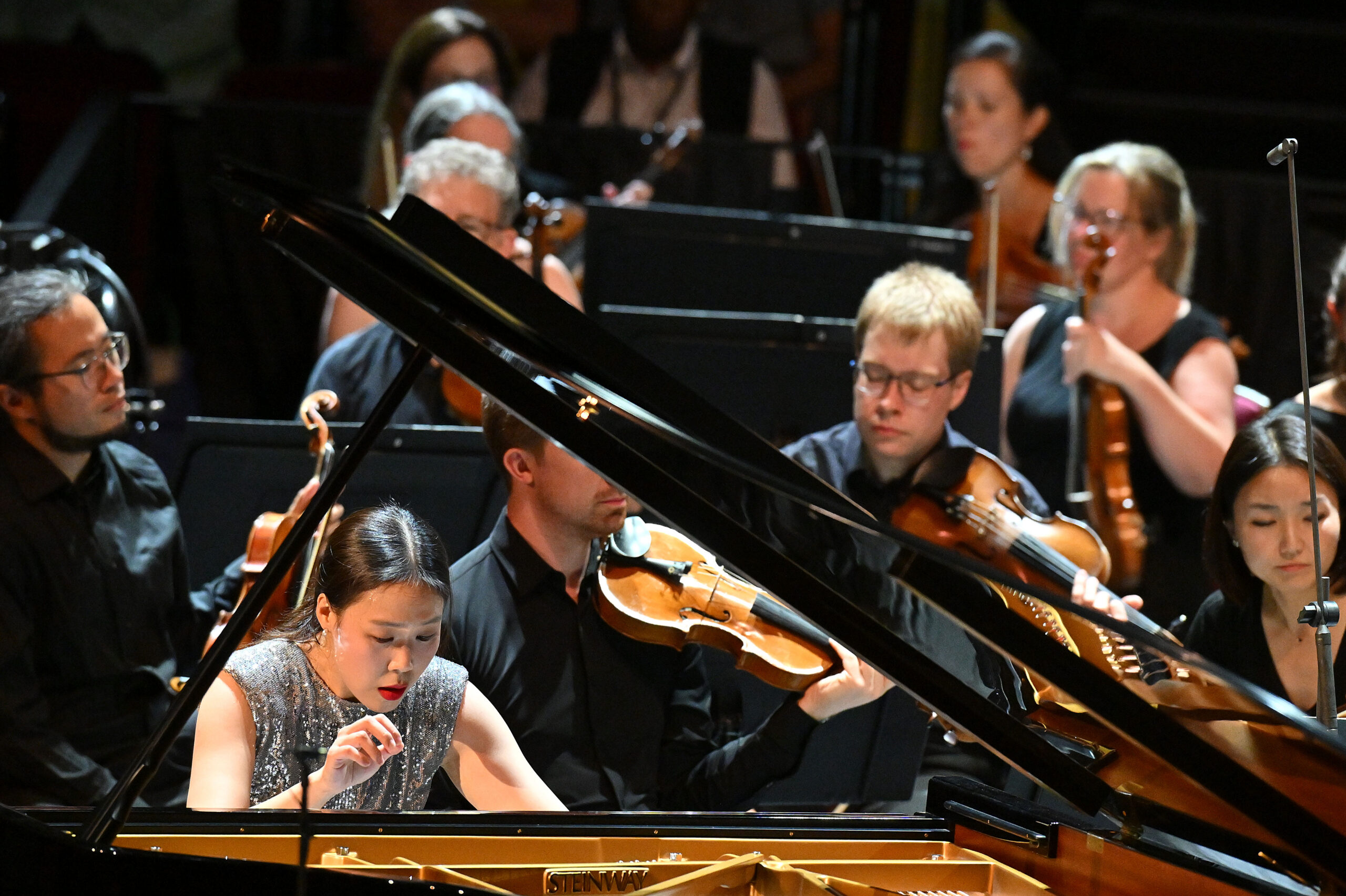
The most interesting and rewarding of the works in this programme is the last – Barber’s Symphony No. 1. What went before was well-executed but materially dissatisfying.
Programme
Wynton Marsalis Concerto for Orchestra (BBC co-commission: UK premiere)
Gershwin Piano Concerto in F major
Barber Symphony No. 1 in One Movement
Yeol Eum Son (piano)
BBC Symphony Orchestra
Conductor: James Gaffigan
Thursday 13 August 2026 · 7pm–c9.15pm
Royal Albert Hall
Listen on BBC Radio 3 / BBC Sounds
Preview
Out of all this year’s Proms, Gershwin’s Piano Concerto in F major is the most problematic. The sound is immediate. We’re all made to feel included. The inattentive will finish the work feeling satisfied simply because they have been — which is, depending on your view, either Gershwin’s greatest achievement or the source of a nagging unease. There is something tiresomely overblown about the whole enterprise: a string of likeable ideas treated in a way that makes cinematic sense, consistently inoffensive, delightful in the moment, but amounting — despite the transitions working adequately — to less than the sum of its parts. We’ve committed to a journey and remained resolutely in the field, oohing and aahing at the show pony doing his tricks, without noticing the sun has already set.
This uncomfortable view isn’t common or universally assumed — a product perhaps of a dissatisfied imagination that spent time with Previn and later a much more animated Jablonski in readiness. It’s functional. It does the job. But the concerto consistently leaves me feeling like I’ve gorged on a bottle of Coop dry white wine in the corner of the kitchen whilst someone else devours the latest releases on their YouTube subscription.
Gershwin came relatively late to music and didn’t follow the European path to credibility. His mastery of melodic invention and overt characterisation was always going to make him a crowd pleaser — but there was a pay-off. He sought formal study from both Ravel and Nadia Boulanger, both of whom turned him down. When an émigré Russian composer asked Gershwin for advice, Rachmaninov reportedly enquired first how much George was already earning. The figure confirmed something Rachmaninov had long suspected — a reality that became the foundation of composition teaching in conservatoires for eighty years to follow: you either commit to art or to money. Some say that choice remains.
Still. It’s got a lot of good tunes. And there are plenty paid good money for that who can’t summon them.
Review
Describing a new work as ‘a lot of fun’ — as many commentators have about Marsalis’ Concerto for Orchestra work when it was premiered last year — can be misleading. The work certainly holds attention by throwing a Great Many Ideas into its six movements. We’re dazzled by the juxtaposition of styles. There is, across its 37 minutes, something for everyone. And maybe that’s what contributes to a growing dissatisfaction listening to it: there’s little time for anything to go too deep. Whilst there is story and a discernible narrative spine, musical indigestion follows several courses of musical canapés. The grumbling heartburn sets in around the middle of the third movement. Come the fourth movement, the fact that nothing sticks around long enough to develop irritates; boredom sets in soon after. It’s technically demanding — constantly shifting time signatures and speeds. This relentless shape-shifting feels less like genuine stylistic range and more like a work straining to look inclusive — present-day by numbers, and pleased with itself for it. Come the conclusion of this over-seasoned work, when it finally arrives, the sense is of collapse narrowly avoided. All that miserable scepticism expressed, it is a programmer’s dream — a reliable crowd-pleaser for any organisation seeking to break down barriers in classical music. It’s also a work that is orchestrated within an inch of its life, getting good value out of everyone on stage.
Gershwin’s Piano Concerto sits more comfortably in the broadcast after the Marsalis, in comparison to the preview in this post. The work works, just. There might be something reassuringly familiar about Gershwin’s world too. An odd feeling given that it’s not that far away from Marsalis’s. But that reassuring feeling passes as quickly as the joy experienced revelling in Richard Addinsell’s Warsaw Concerto on a first listen. Gershwin’s Piano Concerto still feels like a work that occludes the soloist, making ‘concerto’ a misnomer. We’re being entertained, not invited into a musical argument: the spectacle sparkles brighter than the argument is given space to develop. It’s as though we’re listening to an extended overture to a pre-war Broadway show. In this way, commenting on a soloist’s interpretation of a polished piece of orchestration is to credit too much to the work. Gershwin’s Piano Concerto at the Proms is a vehicle for 2011 Tchaikovsky Piano Competition Silver Medal Winner Yeol Sum Son that denies her something valuable. The playing is sound, but let’s hear something from her where the musical line isn’t contributing to the musical whole, but instead enabling the musician to place a flag in the sand and make a solid statement.
Gaffigan makes a sound and reassuring case for Barber’s Symphony No. 1 – the authority in his pre-performance pre-recorded audio has a similarly affirming effect as the work itself. Barber’s concise score is a solid touchstone. Easily the most interesting and most rewarding element in the programme – narrative beats decoration every time.
There’s jeopardy in the performance. The mix is close-in in places, denying a sense of the wider story early on. Brass dominate; strings feel like they’re clinging on for dear life. One of the early bassoon solos hints at the peril assumed to be felt by all. The fugue in the strings has an infectious urgency. The roller-coaster final sequence throws a much-needed arc light on Barber’s concision, deft orchestration, and devilish demands on the woodwind. Listening is as though we’re sat alongside them playing it with them.
This is music that makes a wind player wish he’d met the composer, and a student conductor regret he didn’t propose the work for his final exam. That this was written nine years before Grimes emphasises the liminal space the composer occupied – the high, dry timpani evoke East Suffolk in an instant. Barber’s Symphony No. 1 was a work and a performance that threw shade on that which went before it in this concert.
Gallery