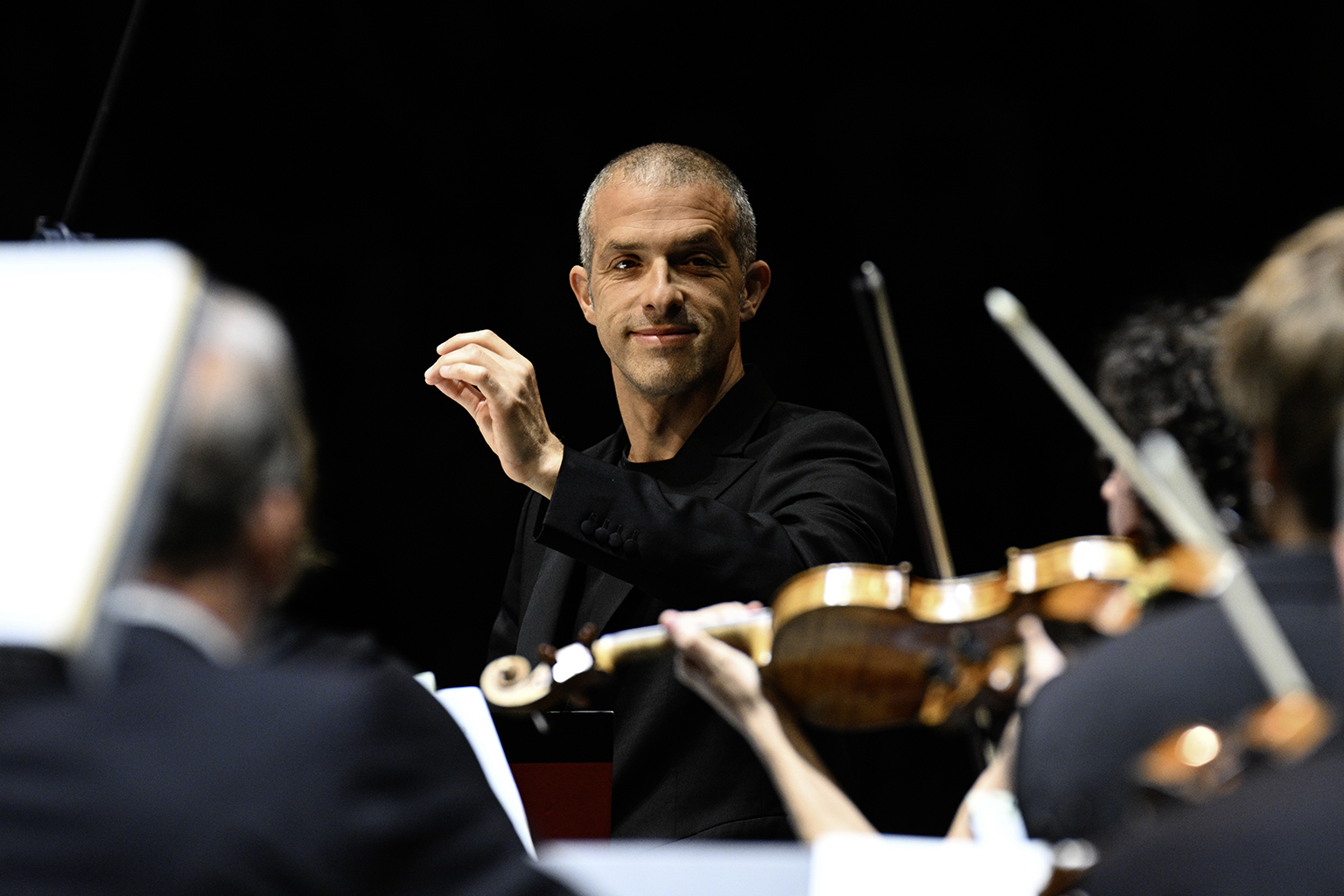
Daniel Lozakovich performs Bruch’s Violin Concerto No. 1 in G minor with Deutsche Kammerphilharmonie Bremen
Programme
Haydn Symphony No. 44
Bruch Violin Concerto No. 1 in G minor
Schumann Symphony No. 4 in D minor (revised version, 1851)
Daniel Lozakovich (violin)
Deutsche Kammerphilharmonie Bremen
Conductor: Omer Meir Wellber
Friday 31 July · 7.30pm – Royal Albert Hall
Preview
Bruch’s First Violin Concerto, completed in its present form in 1867, is one of the most popular of the romantic concertos — and like its partner in crime written by Mendelssohn forty years earlier, skirts wallpaper status. Where Mendelssohn’s crowd-pleaser has an almost twee lightness about it, Bruch’s has considerably more emotional heft, predating Brahms’s heavy-lifter by eleven years. Tchaikovsky’s concerto, written in the same year as Brahms’s, feels like a work topped with a little too much icing and edible gold by comparison. Sibelius cast a shadow on the lot of them with his epic, brooding statement in 1905 — though not so long a shadow as to obliterate the mighty Beethoven’s, written ninety-nine years before. Not everyone will agree. No matter.
Right from the opening of the first movement, the initial statement feels operatic — a clear starting point from which we pass through tension and yearning before arriving, in the third movement, at resolve. Bruch concludes with judicious spectacle: nothing overworked, overplayed, or overwrought. Simply a quickening of the pace, a little tickling at the top of the fingerboard, and then a grand rumble from the orchestra to signal the end. Heartfelt, efficient, and tidy. If Bruch’s Violin Concerto were your first boyfriend, you’d happily introduce him to your mum.
Review
This is a curious performance that demands revisiting on catch-up. On a first listen, conductor Omer Meir Wellber comes across as part-belligerent, veering surly, part-wannabe iconoclast in his dismissal of historically-informed performance in favour of on-stage ‘telepathy’.

The pre-concert hype — made more obvious by a hard edit in the interview — is earned for the Haydn Symphony No. 44. The sound is edgy, rugged, but joyous — the strings have a satisfying articulation that seems to rattle. The contrasts are extreme and work narratively — as though it’s a wintry morning with generous upturned collars protecting against the edge of a morning the determined sunlight is seeking to impose the very best of itself on. This piques interest. So far, the hype is earned.
The second pursues a similar aesthetic but materially doesn’t yield sufficient contrast to follow through and maintain attention. The third movement is the pivot: stately, tenacious, committed. Stripped-back resources work hard with sparse material. Attention secured until 0:14:37 when a wrong note in the cellos (usually acceptable and undetectable) momentarily throws focus off. The core of Wellber’s strategy is held onto.
The final movement is riotous in comparison. Part joy part peril, violins thunder gruffly, the tension contained by tautly articulate high register material in the upper strings. It’s dramatic, almost theatrical. The accents are extravagant — a satisfying foil for anyone whose day has been peppered with the ignorance or incompetence of others. There is a moment when it feels like Wellber may well be pushing Haydn about as far as the work will tolerate his whimsical aesthetic. At the final chord, it sounds like whoever edited that pre-performance interview has just about got away with it.
Bruch Violin presents on paper as a guarantee, an easy win. In performance this felt miraculous, though not necessarily for the right reasons. There were hints of what was to come in the two opening statements from the violin: held-back cadences that toyed with expectations not so much flirtatiously as devilishly. As the subject was laid out so the strategy of drawing things out more than usual was reinforced. Long rubatos and over-emphasised pauses around pivots seemed to hint at the same idea of hype. In those moments when Daniel Lozakovich did up the speed then all appeared caught by surprise — woodwind and strings heading off at different speeds full of intent but not entirely sure who to follow. Thank God for the timps bringing order to an anticipated moment of chaos.

We drift into the second movement, less of an emotional lay-by after the tempestuous first movement, more a lengthy period of introspection — vows spoken by the spouse we thought was a good fit but who it turns out is a little more verbose than we’d realised. In this way, the second movement’s expressiveness felt as unearned as it was surprising when, again, someone in the bass or cellos moved too early. Such detailed analysis would otherwise be overlooked had the pace not been quite so pedestrian and, ultimately, indulgent. That line about telepathy looks more of a risk than a USP.
The third movement has a moment of wobble in the opening sequence when it still feels as though there’s a tussle over who’s boss. And whilst soloist and ensemble do keep it together, the varying speeds feel as though each gear change is being negotiated. The narrative line suffers as a result. As the applause dies down, there’s a nagging sense that the chemistry was left backstage. Still, the crowd roared.
This review will be updated in due course.
Gallery
Photography will be added once available.