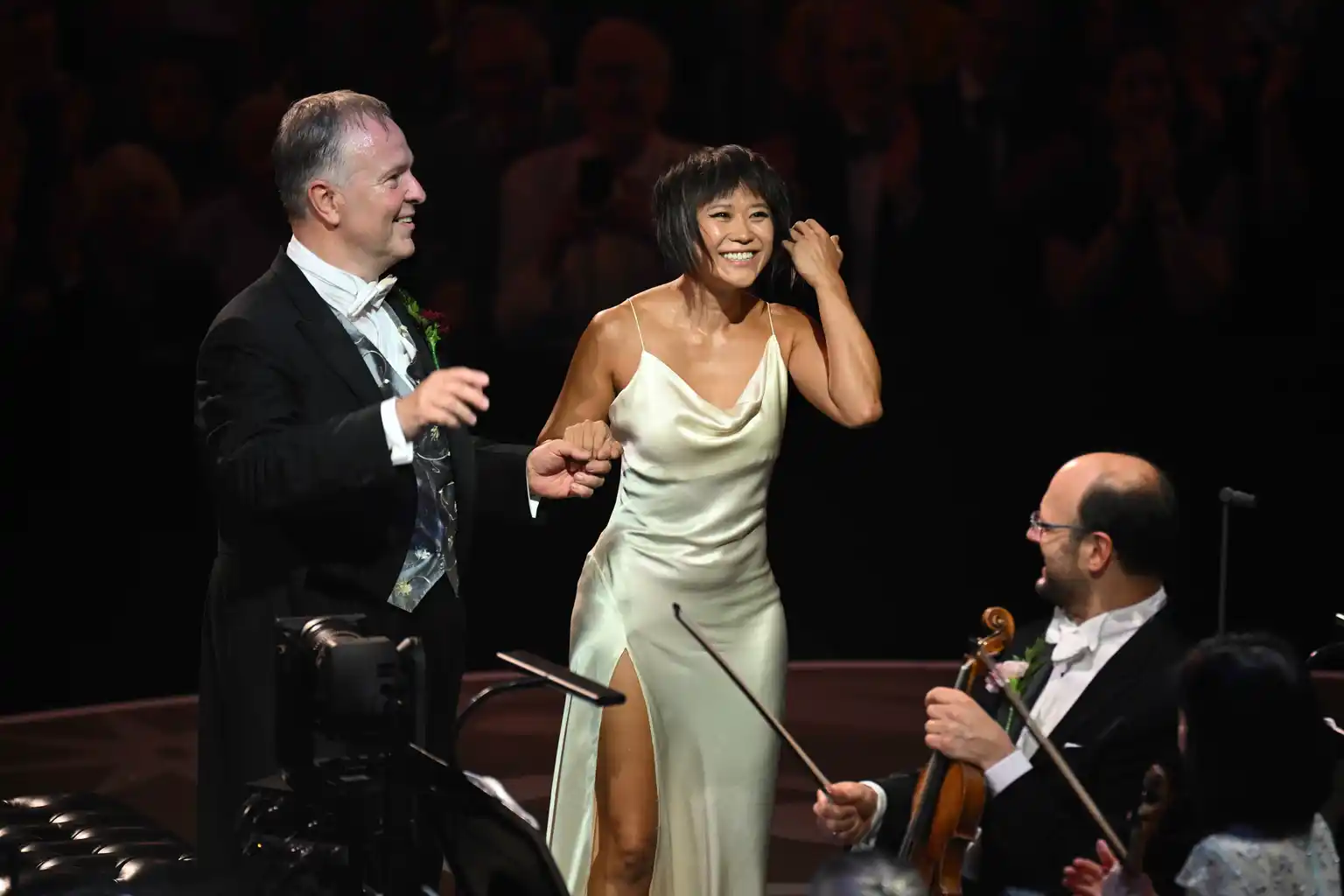
Nicky Spence shone, Dolly Parton got a tribute at ‘world’s greatest classical music festival’, and the BBC turned in a polished Last Night as the Corporation continues to search for £500m of savings.
Programme
Leonard Bernstein: Candide – overture
John Foulds: Keltic Suite – Lament
Antonín Dvořák: Rusalka – ‘Vidino divná, přesladká’ (Prince’s Aria)
Bedřich Smetana: Má vlast – Vltava
Samy Moussa: Dithyramb (BBC commission: world premiere)
Samuel Barber: Piano Concerto
Gustav Holst: The Planets – Jupiter, the Bringer of Jollity
Alexander Tsfasman: Jazz Suite for piano and orchestra
Various Artists arr. Stuart Calvert: Scotch Snap (BBC commission: world premiere)
Anne Dudley: Iris of Life (BBC commission: world premiere)
Frank Loesser arr. Mark Cumberland: Guys and Dolls – ‘Sit Down, You’re Rocking the Boat’
Trad., arr. Henry Wood: Fantasia on British Sea-Songs
Thomas Arne arr. Malcolm Sargent: ‘Rule Britannia!’
Edward Elgar: Pomp and Circumstance March No. 1 (‘Land of Hope and Glory’)
Hubert Parry orch. Elgar: Jerusalem
Anon, arr. Benjamin Britten: The National Anthem
Trad., arr. Paul Campbell: Auld lang syne
Nicky Spence tenor
Yuja Wang piano
BBC Singers
BBC Symphony Chorus
BBC Symphony Orchestra
Sakari Oramo conductor
Listen on BBC Radio 3 / BBC Sounds
Review

Musically speaking, there’s little to hang your hat on in the Last Night except, maybe, for the Barber Piano Concerto. But the Last Night hasn’t pushed the envelope for years now. It is, in 2026, a different proposition: a valuable piece of airtime that helps sell a radio station, promote a series that can still be streamed for sufficient time as the good stuff available demands of your time, and helps convey a striking image about the scale and polish the BBC can still muster in a year when the beleaguered broadcaster reaches for £500m in savings.
This was a live TV light entertainment show with a ticket-buying audience. Presentation was polished but predictably anodyne. Whilst the stage extension created a useful performance area necessary for the dance numbers, the consequence was that the orchestra was even further away from the audience in places. That reduces the proximity and changes the atmosphere.

Some of the performances were a little raggedy – Má vlast, a case in point. Others were at best opportunistic. The lionisation of Dolly Parton was something the Proms found apparently too difficult to resist, hence the inclusion of Ward Thomas, Beverley Knight and Sheridan Smith whose renditions met the editorial need (the walk-through from front of house to the auditorium at the top was fun and playful for TV viewers), but whose backstage contributions were, for understandable reasons, agonisingly and fist-gnawingly dull.
Yuja Wang shone in the Barber, but looked mildly uncomfortable doing everything else. How different things might have been on the Last Night if she hadn’t posted about Norman Lebrecht’s moany email complaining about her withdrawing from his BBC interview series, and had instead pulled out of the final show. Instead, Lebrecht’s series was pulled from the schedules, and the BBC retained one of their big-name draws for the Last Night.

The most powerful element of the broadcast was Nicky Spence, who undoubtedly outshone Yuja, who I’m sure won’t mind in the slightest. Spence is a consistent treasure, both in terms of his voice and his sincerity. Aside from a bizarre filmed insert of him singing Nessun Dorma surrounded by singers traipsing around with candles, the Dvorak Rusalka provided a glimpse of his musical talents, whilst the medley of Scottishness demonstrated his versatility. It also provided another opportunity for BBC programmers to crowbar an adjacent genre reference in the form of a lightning quote from The Proclaimers 500 Miles. Elsewhere in the press the same day, The Proclaimers are themselves promoting their new album, in one interview discussing their views on trans activism and the cancelling of Graham Linehan. On the Royal Albert Hall stage, Spence, flanked by kilt wearing dancers prancing from one side to the other, reveals a sequinned Pride flag stitched into the lining of his kilt. All the references were there, and Spence was the man to deliver it quickly, deftly, and with the right amount of self-deprecation.
Even conductor Sakari Oramo’s speech (written for him, surely) didn’t miss an opportunity in a reference to the BBC’s own top line for the weekend, with a comment about AI. Timely for musicians, though the tautology – Authentic Integrity – caused jitters amongst the wordsmiths.
The Last Night has rarely been my cup of tea, nor as I recall many of the critics who it appeared ready, willing and able, to attend, reflect, and compliment either. This says much about the strategic investment in this key still-anachronistic broadcast. It still risks distracting from what the rest of the UK classical industry does, but then maybe the reminder here is that there’s no such thing as a typical classical music listener. In that respect, it was reassuring to hear Stuart Maconie and (I think – I can’t bear to go back and watch the actual TV programme again) Nick Mohammed point out that this wasn’t representative of the entire season. The communications about the Proms were incredibly joined up with messaging about the mechanics distributed across personal, content and corporate digital accounts almost as though everyone’s lives depended on it. The Last Night looks more polished; the messaging is tightly shaped and reflected across all of its own outlets, its workforce, and third party platforms. That’s a real accomplishment, even if it does still inevitably come at the cost of discovery and heart.
Gallery
The gallery will be updated shortly.