NYO’s Spring Concert at the Festival Hall celebrated what this orchestra has become. The question now is what Principal Conductor Alpesh Chauhan will demand of it next.
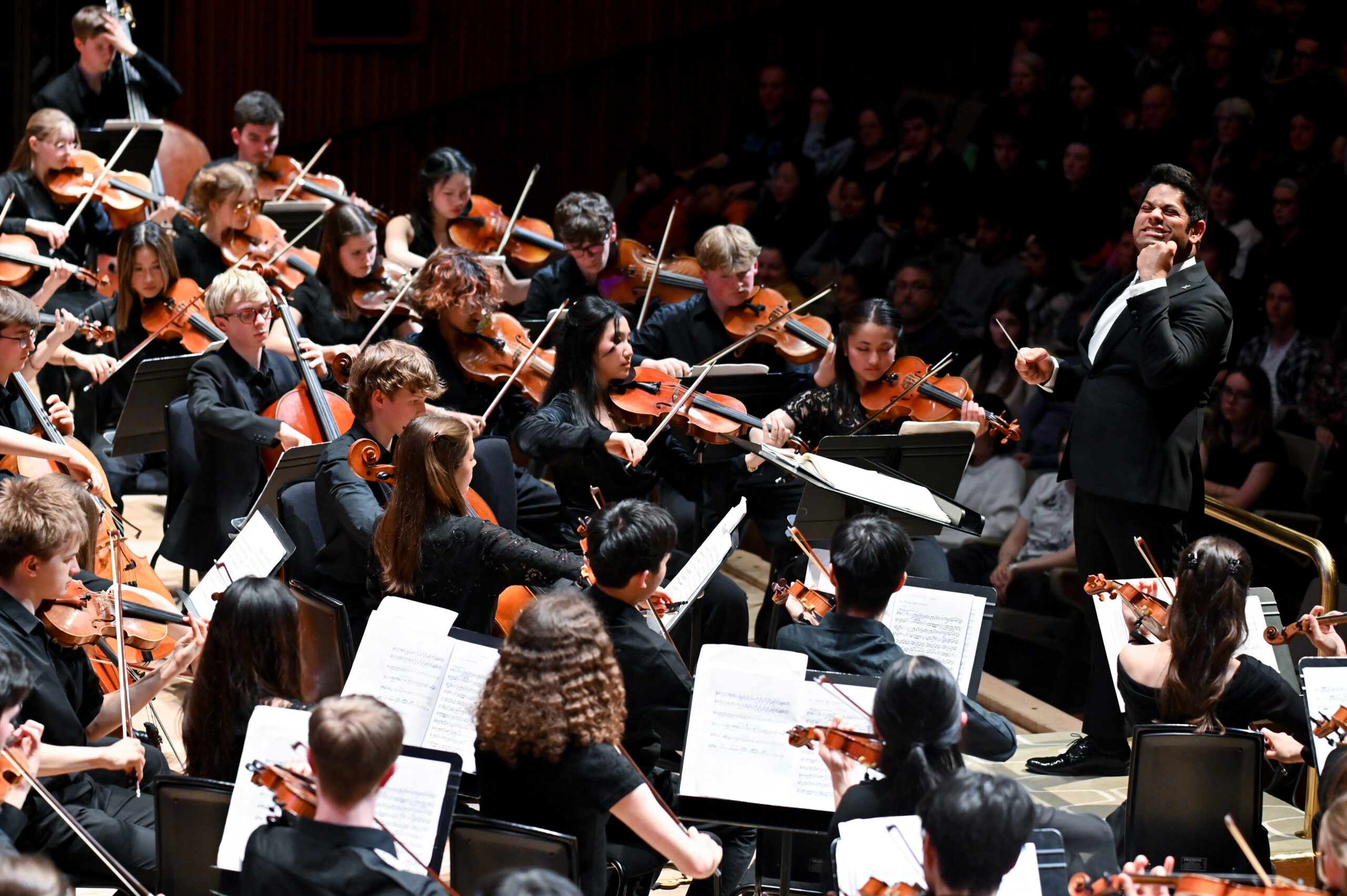
Accompanied by a toe-tapping score for percussion instruments, members of the National Youth Orchestra strode confidently onto the Festival Hall for their final Spring Concert last night, all bright eyes and wide smiles, joined later by recently appointed Principal Conductor and Musical Advisor Alpesh Chauhan. The energy was undeniable and the virtuosity exhausting to comprehend. At 160-strong there wasn’t much room left on the stage and at times frequently little space in the auditorium for some of the fortissimos. This was an experience managed by Chauhan, and therein lies his opportunity in the future.
Programmatically, Joe Hisaishi’s Symphonic Variation on animé classic Howl’s Moving Castle was a sound concert opener, building on the theatrical entrance made by the players. Musically, the score built a strong connection between those on stage and their parents in the auditorium. Hisaishi’s writing successfully navigates the line between film score and concert writing deftly, making playing the score en masse as likely enjoyable as it is to listen to. Delectable Hollywood strings were evident when called for. A well-matched trumpet duet throwing to a piano solo demonstrated great musicianship — a high point in the way colours and timbres combined. Some nerves were evident in solo lines but these were quickly contained in advance of future cues. Whilst the brass could have been pared back in places, the Hisaishi felt the most cohesive musically of the programme.

Wagner’s Prelude & Liebstod suffered a little from the weight of players on stage and Chauhan’s seeming eagerness to steam through the fragile intensity that the score contains. Committed though the performance was, at times the tempestuous interpretation flattened the emotion. Lingering a little more would have helped, so too paying closer attention to the balance and power of the fortissimos. At the top end, the strings struggled to meet the emotional demands in most intense moments.
The excerpts from Prokofiev’s Romeo and Juliet were the most assured. Here was evidence of the greater artistic rigour that felt lacking under Chauhan’s direction in the Wagner. Woodwind were perfection throughout. Fierce brass complemented by taut articulation in the strings was found in the opening scenes. The Dance of the Knights saw some balance issues with dominant brass and percussion overpowering ensemble. The Balcony Scene saw some of the most ethereal string playing of the evening, though if we’re handing out medals it’s to the first violins for their blistering virtuosity when Romeo hits on avenging Mercutio’s death.
The transformation NYO has achieved in the past ten years is considerable. Look beyond the change in the look and feel of its messaging, and there’s a sense its presence is now owned by its membership rather than imposed by a hierarchy. This is seen in its presentation style on stage, the programming, and the way in which musicians talk about the music they’re playing — whether with a microphone in their hand or in the print of the programme. There is an invigorating, unapologetic advocacy for the activity they’re engaged in: a strong indicator of where the sector might head in the next twenty years. That 44% of last night’s audience were under 19 and admitted free from the local area underlines the point. What’s less clear is whether that same energy is being matched by an equivalent demand for artistic edge — and whether Chauhan, in his first season, is yet exacting enough to find it.
A recording of the NYO’s Broadwater Hall performance on 9th April will be broadcast on BBC Radio 3 on 1 July.