Rachmaninov played in Hastings twice, so everyone keeps saying. What the Hastings International Piano Competition does with that legacy — and whether it can build the profile and reputation to match it — is a more complicated question.
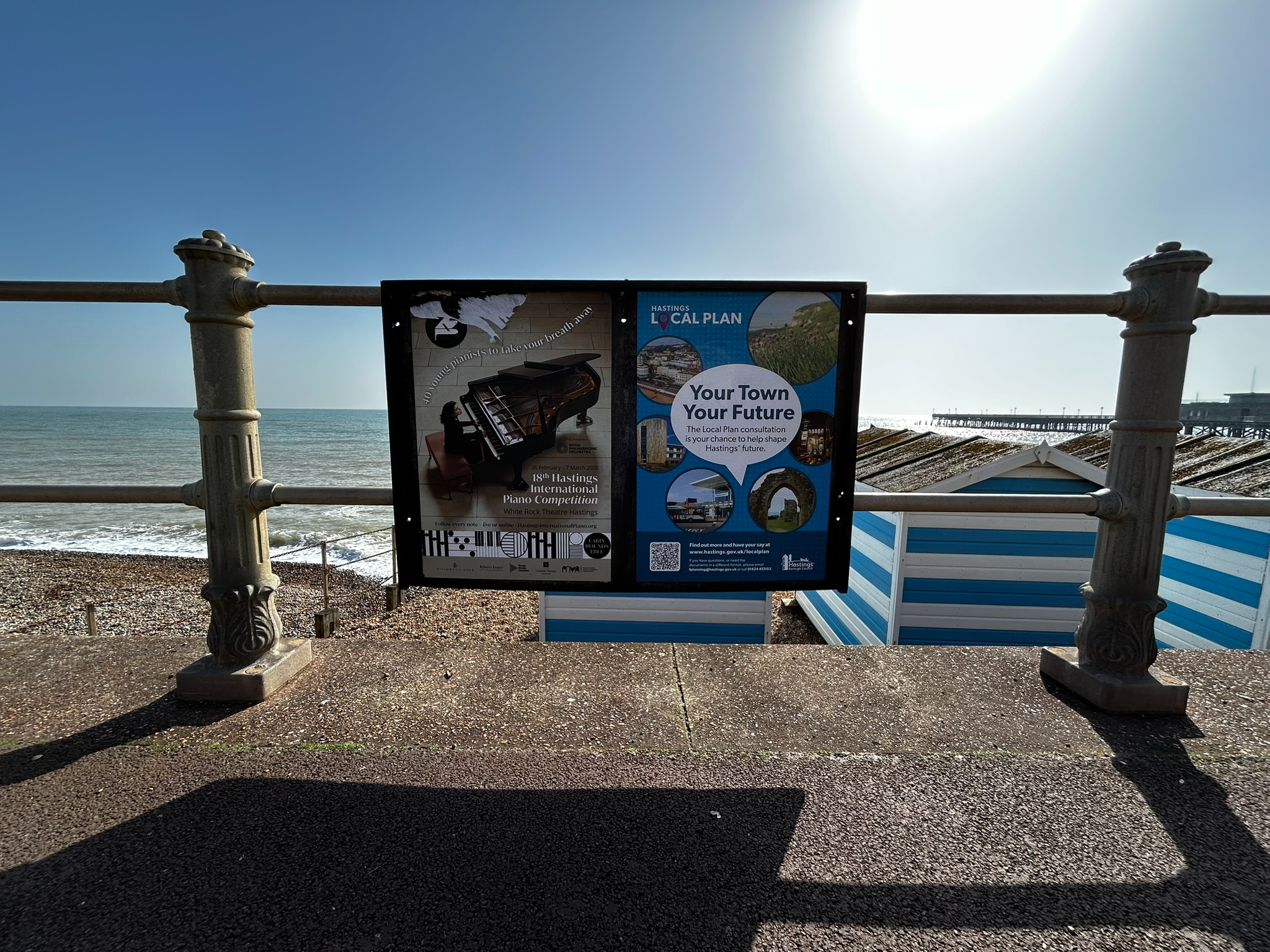
Hastings. Early March. The sun is warm. The sky is a searing blue. The sea air has a pleasing chill. I’m here for the semi-final of the Hastings International Piano Competition staged at White Rock Theatre. A theatre that sits squarely on the seafront with a 90s facade that masks its legendary past. Inside, plasterwork in need of urgent repair goes overlooked or unbudgeted.
This is not where I’d expect an international piano competition to be. Cutesy eateries, tattoo shops, and contemporary art galleries gesture at being Brighton. Elsewhere, homeless people hover outside boarded up shops.

Inside the White Rock Theatre, hastily written names on a whiteboard announce tonight’s competitors – one from the US, the others from China and Canada. Clear instructions on the doors to the auditorium politely request quiet. In the foyer front of house staff converse at pace and at volume.
What I hear of rehearsals I like. There’s energy and urgency. One competitor seizes the opportunity of a break in rehearsals to hammer out sequences in the third movement of Beethoven Piano Concerto No. 3. There’s a sense he’s making a bid for connection to those remaining players on stage busily practicing their parts. A warm up or a bid for connection? It’s both awkward and heartfelt.

The orchestra reconvenes. There’s a rumble of appreciation for the pianist at the keyboard. There might even be a hint of potential-competition-winner-warmth. A prediction, maybe. There’s industry in the rehearsal when it gets underway. Then, behind me, commotion—venue staff choosing this moment of all moments not only to move chairs and tables from the auditorium to a nearby function room, but to laugh, joke and commentate on their actions.
Warm-hearted staff recount the competition’s origins in the town’s Festival. Rachmaninov played here. Twice. Vaughan Williams conducted his fourth symphony here too. All the major London orchestras performed at White Rock Theatre. It feels like another age to imagine it. Is the competition trading on its past whilst overlooking its future?
Change is already afoot. Head Judge Professor Vanessa Latarche has led the beginnings of transformation, bringing her reputation, connections and pedagogy into the competition. The numbers reflect it, even if the standard remains uneven. Applications for this year’s competition have increased from 200 to 350, whittled down to forty participants. After two rounds, ten semi-finalists perform a classical concerto with Sinfonia Smith Square. Five finalists perform their romantic concerto of choice with the Royal Philharmonic Orchestra the day after. Quite the turn around.

After rehearsals I speak to Competition Director Ian Brignall. Part-administrator, part event producer, and reliable concert manager, Brignall is warm, generous, and candid. I refer to the small committed team and ask whether he or it is overstretched? Yes, he replies, but of course, a competition that is run every two years for just a few days doesn’t need just bodies, but experienced people. That’s difficult to find. Aside from profile, I ask, what does the competition need most now? Money, he replies. How much money does something like this need? £300K.
There’s so much more to do here, I venture. That drawing together judges and building connections in the industry is such a big ask of one person — Vanessa Latarche. Ian heads off to get changed for the semi-final and leaves me to think, as I head to the bar for a small glass of red priced at £6.50 served from a bottle retrieved from a glass shelf in desperate need of a dust.
Then something quite unexpected occurs. As I head up to the circle the Marketing Director waves at me as I pass her and introduces me to a recognisable face. The face is familiar before the context is. Geoff Parkin — former head of the Royal Overseas League Music Competition. “This is our new CEO,” says the Marketing Director. Geoff it transpires will soon be heading up the Hastings International Piano Competition. “I can include that in the write up, can I?” I ask the Marketing Director. “Why not?” comes the reply.

In the auditorium, audience turnout is good. 60% house for semi-final two. Online, the streaming figures for the competition YouTube account say something different with a downward trend from the first round. A 4.5K opener dwindles to 2.5K come the first semi-final. Opening the second semi is Adria Ye from the US whose technical proficiency throughout Beethoven’s fourth piano concerto is compelling. Sometimes the ensemble is a little off, but the graceful phrases are consistent. There are moments when the notebook is put down and attention secured. The performances that follow struggle to live up to the opener, which makes the final an interesting proposition. Taken as a whole however, the second half loses my focus. I leave in pursuit of my last reasonable train home.
Hastings International Piano Competition isn’t confident asserting its position. With a new CEO soon to start, it ends its 18th competition on the cusp of new development. Potential is more energising than legacy.
The Hastings International Piano Competition Final is streamed live on YouTube on Friday 6 and Saturday 7 March 2026.