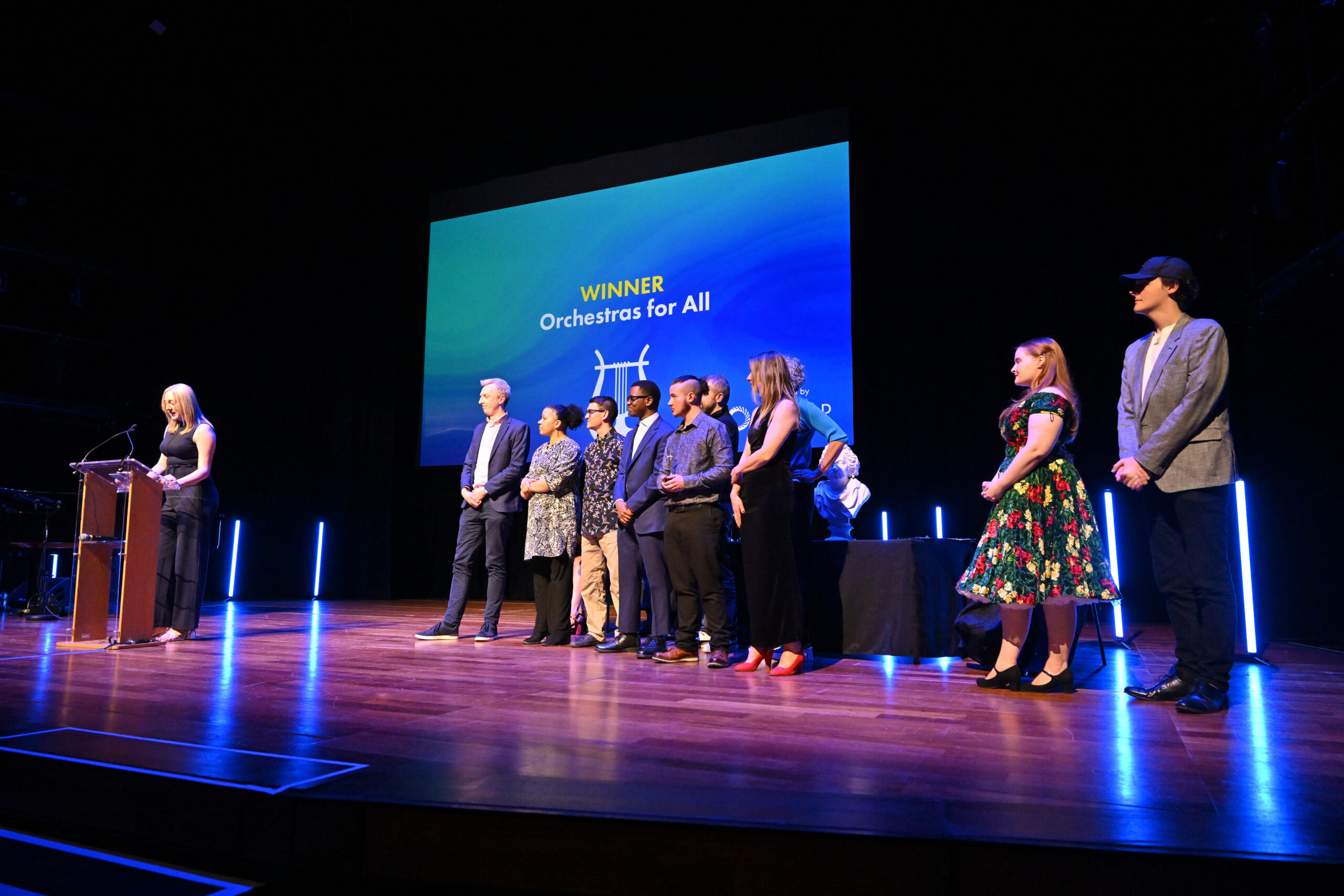
The Royal Philharmonic Society Awards were a stylish affair full of wit, polish and verve. Classical music as self-assured and defiant. There’s still work to be done, and a timely message for some to keep checking their spam folder.

The RPS Awards held last night at Queen Elizabeth Hall in London, reveal a sector that is genuinely comfortable in its own skin, not simply because everything is fine, but because it knows what it values. A sector with impetus. Perhaps even defiant.
Awards given out are one thing. The stories told in the acceptance speeches are truer. You’d expect RPS Chief Executive James Murphy to make an impassioned case for the genre, drawing on his own origin story and how hearing the Galaxy advert as a kid introduced him to Gershwin’s Rhapsody in Blue.

Matilda Lloyd’s win for Young Artist saw her living the argument she’s making about needing to be more women in brass. Louise Alder stole the room with a distinctly human angle, stepping onto stage to collect her Singer award with her two-week old baby. Instrumentalist winner Peter Moore maintained a likeable nonchalance. He may have won the BBC Young Musician competition in 2020, had a stint in the LSO, and various high profile concerto appearances, but his throwaway remark that any agents in the room might want to check their spam folder was suitably pointed.

Southbank’s win for its Multitudes series was deserved, if undermined by the tin-eared messaging which emerged in the pre-publicity for its Mixtape experiment. The figure for Multitudes speaks for itself: over 50% of attendees were new to classical music. But the pertinent question remains: just how many returned? The answer is found in a figure that wasn’t shared.
Jacob Collier’s Gamechanger Award arguably does more service for the RPS and the wider sector than it does for him as musician, composer and educator. A considerable social media reach, Collier’s highly charismatic presence wins hearts. He cleverly combines expertise and whimsy, projecting his craft as something to aspire to. Though that profile attracts as much pushback as it does admiration — particularly from musicians of his own generation on YouTube — it helps classical music’s sector-wide PR challenge far more than he needs the recognition.

The most authentic moment in the room came from the winner with the smallest mandate — just 6,000 votes. Kirkcaldy Orchestral Society secured its win in a category voted for by the public. Collecting the award, the Society conveyed both pride and humility that underlined the impact its broad range of activities has on its community. Not simply a calling card, but a blueprint for communities looking to do the same.