Debussy’s score constructs an intense interior world and plants ideas in the mind of the listener. Rory Kinnear’s direction strips away distraction. Ideas grow during and after performance. This stuff lingers.
Debussy’s Pelleas and Mélisande is long. At three and a half hours including a 25 minute interval, conductor Ryan Wigglesworth’s summoning of Debussy’s epic setting of Maeterlinck’s 1892 play nudges three hours. I’m relieved I’ve brought my two foam seat cushions. I’ve also tested out the new seats soon to be installed in Snape Maltings Concert Hall ahead of next year’s festival. The present is manageable. The future looks and feels comfy.
Long in this context doesn’t mean uncomfortable. Materlinck’s text holds those unfamiliar with abstract symbolism at a distance; Debussy’s score, in comparison, not only welcomes and accommodates, but constructs the very experience language struggles to describe. The music is the point. Little wonder the orchestra is in vision and not in the pit. This is a dark world – the text says as much – and the music maintains a brooding feel, intensity held throughout until in the moment preceding an emotional climax, it can be held no more. Debussy’s score plants these ideas in the mind of the listener. Those ideas grow during and after performance.

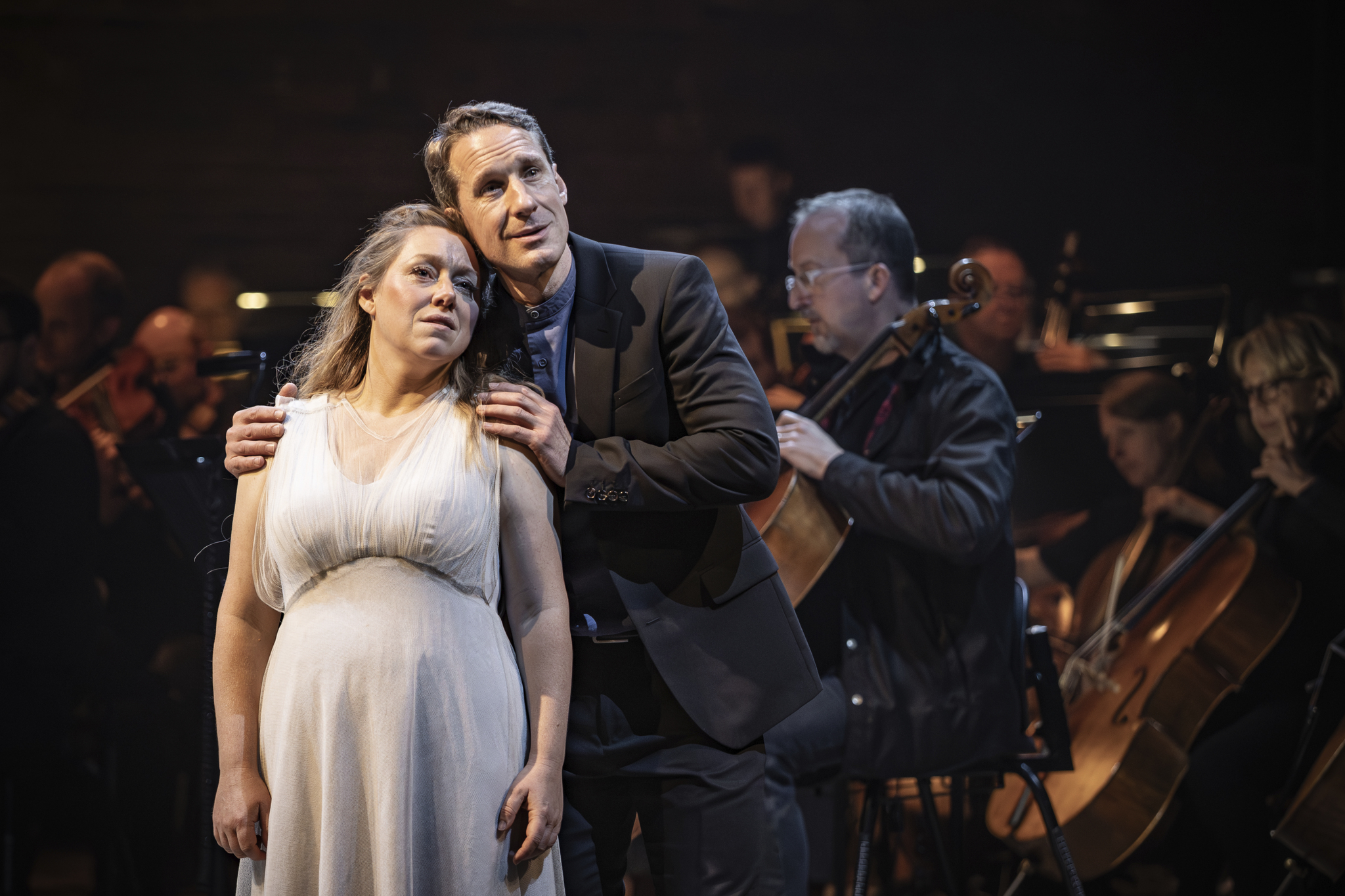
Much of the effect that a first listen to this opera has is down to a combination of pared back staging and orchestral interpretation that takes its time to make sense. Director Rory Kinnear avoids overt scene setting, relying instead on light, and the objects present on stage – conductor’s podium, stool, orchestra, and light. It would be easy to dismiss this as a pragmatic response to a limited budget. More interesting is to consider it as an intentional design choice, simplifying abstract concepts by reducing distraction and relying solely on the expressive qualities of the music, and storytelling craft demanded of the cast.
Conductor Ryan Wigglesworth is meticulous, drawing from the BBC Scottish Symphony Orchestra sounds that are distinct from existing recordings, defy vague recollections of previous performances by the orchestra, and maximise the acoustic qualities of the Maltings. Everything is carefully deployed, well-balanced, and particular. Dry string textures (you can really feel the hair at the heel of the bow) combined with voluptuous wind sonorities deftly avoid a mawkishly sentimental read of Debussy, giving this interpretation a sometimes period performance feel. Horns in particular are rounded and warm. Principal oboe and cor anglais create the most connected moments with the smallest of solo contributions, compensating where language deliberately fails. I don’t think I’ve ever heard a BBC orchestra sound quite as good as this, so consistently over such an extended period of time. They create something necessary seemingly without fuss or bother.

For a performance that leans heavily on the individual performer, casting plays a critical role in its success. Jacques Imbrailo retains the same painfully earnest vulnerability he displayed as Billy Budd, even from a distance. His voice production is impeccably comforting. He combines this with acting technique – a slightly stooped stance that conveys nervousness and excitement that alone pulls focus away from the surtitles and sees us trust simply in the score and what plays out in front of us.
Sophie Bevan as Mélisande appears as a high maintenance complex character, unwilling to give away much other than a gruff face and a clear open palm instructing anyone coming near to keep their distance. But this is Melisande simply not knowing how to describe what it is she is experiencing beyond not being happy. Exactly the point symbolism is trying to edge us towards: there are forces which cannot be identified that we are subject to. To know them is to – ultimately – be trapped in destruction. In this way Kinnear’s direction doesn’t invite pity for Mélisande so much as permit us to observe the character and the frustrations of a husband whose paranoia feeds on everything he cannot know.
Sarah Connolly’s Geneviève delivers bad news with sophisticated understatement, a stylish gravitas created by the combination of a sleek black costume and a burnished voice. Here in particular, Kinnear’s directorial strategy focuses attention on presence rather than content. Connolly is an unconventional beacon in a world full of darkness.

The largest part of the company in scale is then the orchestra as a whole. The near 70 members of the BBC Scottish Symphony should technically dominate the space both physically and audibly. Yet the nifty part risen stage extension creates theatrical direction, and a set around which characters can move and interact. It could easily have felt overworked. The result felt naturalistic, instinctive and absorbing. Sound as a constructed world in which ideas are expressed and explored.
Maeterlinck’s play never quite reached the audiences that Debussy’s setting achieved. Set against late 19th century preoccupations with what human identity was actually based on, the opera works as a musical summoning of forces that Symbolists claimed were beyond language — and yet, counter-intuitively, makes the case for language in the process. Gordon Bintner’s Golaud commanding Beth Stirling’s brittle Yniold to articulate what she sees of Pelléas and Mélisande together was especially evocative here: we cannot escape our need for truth in the way Golaud cannot rest until he has it. In showing how that compulsion to know and see leads only to destruction, the opera occupies the same contested ground Freud was staking out in 1899.
The grappling demanded of us as we occupy this interior world has a bleak quality in spite of the sensuality in Debussy’s compositional choices. This production earns that bleakness honestly: stripping away distraction, it focuses on light, sound, and expression — the minimum needed. The commitment it demands is bigger than three hours in the auditorium. This stuff lingers.